Every day, businesses generate millions of hours of video, creating overwhelming amounts of visual data. AI video understanding transforms how companies handle this content. It automatically analyzes footage, identifying objects, faces, activities, and spoken words—tasks that once took teams hours now happen in minutes. From security monitoring to marketing insights, this technology uncovers hidden patterns, saves time, reduces costs, and helps businesses of all sizes work smarter. AI video understanding delivers real, measurable results that impact your bottom line.
Let's explore how this technology can transform your business operations today.
What AI Video Understanding Technology Does for Your Business
AI video understanding uses computer vision and machine learning to automatically analyze videos and identify key moments. By leveraging AI video analytics, it transforms raw footage into actionable insights, recognizing objects, detecting actions, and understanding context—including spoken words—without manual effort. This lets businesses save time, uncover valuable information, and make smarter decisions using their video content.
How Computer Vision and Machine Learning Interpret Video
Computer vision forms the “eyes” of AI video understanding. It lets machines analyze videos frame by frame, identifying objects, patterns, and activities. Machine learning models power this process, training on millions of videos to recognize everything from simple items to complex actions.
The process works through several sophisticated steps:
- Frame extraction: AI breaks video into individual frames for analysis
- Feature detection: Advanced ai techniques identify important visual elements in each frame
- Pattern recognition: Learning models compare what they see against their training data
- Context understanding: AI techniques piece together individual frames to understand the bigger picture
- Continuous improvement: Self-supervised learning helps models get smarter over time
Self-supervised learning is a breakthrough for AI video understanding. Instead of needing humans to label data, these systems learn automatically, discovering patterns, relationships, and context. Modern AI video understanding goes beyond recognizing objects—it understands actions and situations, interpreting video at a deeper, more meaningful level.
Key Benefits of AI Video Understanding
AI video understanding unlocks benefits that directly impact your bottom line and operational efficiency. This technology addresses critical challenges organizations face when managing video content at scale.
The advantages create measurable value across departments and industries. They transform video operations from cost centers into strategic assets.
Let's explore how ai-driven video solutions deliver tangible results for your business.
Automate Time-Consuming Video Analysis Tasks
Manual video analysis is slow and resource-heavy. AI video understanding can process footage instantly, handling repetitive tasks like tagging, quality control, and compliance checks. This lets teams focus on creative and strategic work instead of tedious review.
Organizations using AI video understanding report huge improvements in speed and accuracy. What once took days can now happen in minutes. The system flags issues, applies tags, and routes content automatically—reducing labor costs, accelerating time-to-market, and allowing operations to scale efficiently.
Unlock Insights from Long Videos and Large Video Libraries
AI video understanding makes it easy to extract meaningful information from long videos and large libraries. It identifies key moments, detects patterns, and uncovers insights that manual review might miss. Organizations can analyze surveillance, training, or customer footage to discover trends, optimize operations, and make data-driven decisions. By turning raw video into structured, searchable data, AI lets you find specific objects, actions, or events in seconds, unlocking the full value of your video content.
Improve Accuracy with Advanced AI Techniques
AI video understanding overcomes human limitations like fatigue, inconsistency, and subjective judgment. Advanced algorithms deliver consistent, reliable analysis and continuously improve over time by learning from diverse content. In tasks like content moderation, AI applies uniform criteria, detects subtle anomalies, and identifies rare events across videos—often exceeding human-level accuracy while ensuring dependable results every time.
| Business Challenge | Traditional Approach | AI Video Understanding Solution | Measurable Impact |
|---|
| Processing Time | Hours or days per video with manual review teams | Minutes per video with automated video analysis | 75-90% reduction in processing time |
| Scalability | Linear cost increase requiring more staff for more videos | Process thousands of videos simultaneously without additional headcount | Process 10x more content with same budget |
| Accuracy & Consistency | Variable results affected by human fatigue and interpretation | Consistent precision across all content with continuous learning | 95%+ accuracy maintained on every video |
| Insight Discovery | Limited to surface-level observations from sample reviews | Deep pattern recognition across entire libraries revealing hidden trends | Uncover actionable insights from video previously missed |
| Cost Structure | High operational expenses with ongoing labor costs | Lower per-video costs that decrease as volume increases | 40-60% reduction in total video processing expenses |
These benefits combine to create competitive advantages beyond simple cost savings. Organizations gain agility, intelligence, and new capabilities. They fundamentally change how they leverage video content for business success.
Practical Use Cases Across Industries
Organizations use AI video technology to solve diverse challenges and unlock new opportunities. These applications show how video understanding creates real business value. Companies deploy these systems to handle safety concerns and boost operational efficiency.
Different industries apply the same core technology in unique ways. A retail business uses it differently than a media company. Both benefit from the same underlying capabilities.
Keeping Communities Safe Through Intelligent Content Moderation
AI video understanding helps online platforms manage user-generated videos at scale by automatically detecting policy-violating content. It analyzes visuals and audio simultaneously, spotting violence, harmful speech, and other risks. This allows acceptable videos to publish immediately while flagging potential issues for review. It also reduces the psychological burden on human moderators, letting them focus only on edge cases and keeping communities safe.
Finding Exactly What You Need With Video Summarization and Smart Search
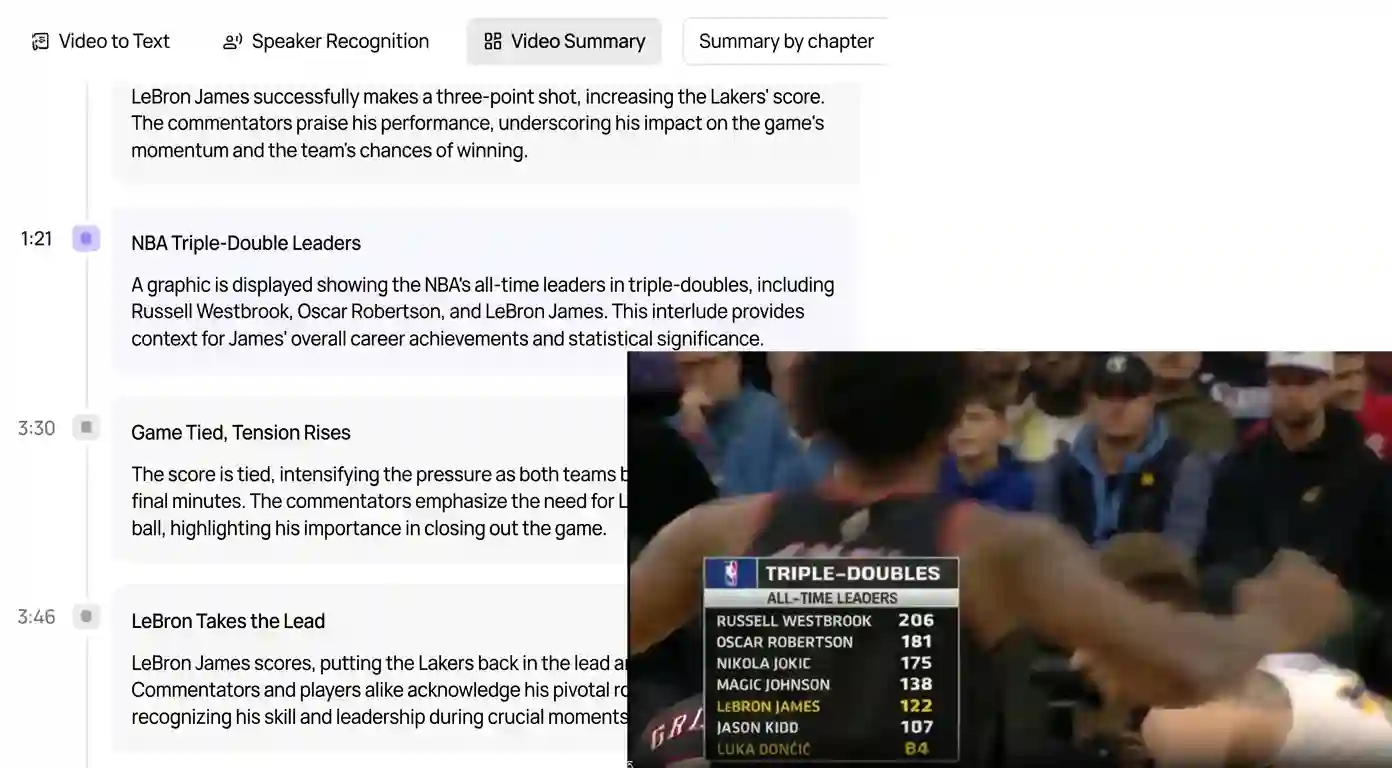
AI video understanding makes it easy to find key moments in long recordings. It can summarize videos into short highlights and allows users to search with natural language queries to locate exact segments. This saves time, helps students, employees, and viewers quickly access specific information, and enables content owners to get more value from their video libraries.
Extracting Business Intelligence Through Object Detection and Video Classification
AI video understanding uses object detection and video classification to turn raw footage into structured, actionable data. Retailers can analyze customer behavior and optimize store layouts, manufacturing teams can automate quality control and safety checks, and security operations can monitor streams and receive alerts for specific events.
Logistics companies use object detection to monitor warehouse operations and inventory levels. The technology counts items, verifies shipments, and tracks package movement. This visibility improves accuracy and speeds up fulfillment operations.
| Industry Sector | Primary Use Case | Key Video Understanding Task | Business Impact |
|---|
| Social Media | Content Moderation | Policy violation detection across video and audio | Safer platforms with 85% reduction in human review time |
| Education | Video Search and Summarization | Semantic search with natural language queries | Students find information 10x faster than manual search |
| Retail | Customer Behavior Analysis | Object detection and movement tracking | Layout optimization increases conversion rates by 15-20% |
| Manufacturing | Quality Control | Video classification for defect identification | Defect detection improves by 30% with consistent standards |
| Security | Threat Detection | Multi-camera object tracking and event recognition | Response times decrease 60% through automated alerts |
Building Custom Solutions With Automated Video Workflows
AI video understanding enables businesses to create automated, tailored video workflows. Organizations can chain multiple processing steps—such as content moderation, metadata generation, summarization, transcription, translation, and format conversion—without manual intervention. This approach ensures consistency, speeds up production, and scales efficiently across large video libraries. Industries from media to healthcare can customize workflows to their needs, freeing teams to focus on high-value creative work while AI handles routine analysis.
Embrace the Power of AI for Video Content
AI video understanding turns time-consuming video tasks into automated workflows, helping businesses of any size extract insights instantly. Whether managing thousands of hours of footage or daily customer submissions, this technology improves efficiency, speeds decision-making, and enhances customer service. Companies can start small—testing AI on content moderation or video search—and gradually expand to more complex applications. With ready-to-use APIs from providers like Google Cloud, businesses don’t need data scientists to get started. Those who leverage AI video understanding today will gain a competitive edge as video becomes increasingly central to operations.
How can AI video understanding help my business save time and money?
AI can automatically tag, categorize, check quality, and review compliance in videos, so you don’t need people to watch everything manually. This speeds up workflows, cuts costs, and lets staff focus on more valuable tasks.What are multimodal AI models and why do they matter for video processing?
Multimodal AI can understand visuals, audio, text, and speech at the same time—like a human watching a video. This allows for more accurate summaries, smarter searches, and better content moderation.Can AI video understanding handle different video formats and lengths?
Yes. Modern AI handles all common video formats and any length—from short clips to hours-long videos—and can even process huge libraries efficiently, making it flexible for all kinds of business needs.