

AI Video Surveillance: Revolutionizing Security and Safety with Cutting-Edge Video Analytics
AI video surveillance solutions are fundamentally reshaping how businesses and individuals keep watch over their surroundings, detect potential threats, and bolster safety through intelligent analytical capabilities. This deep dive explores how AI-powered video analysis delivers real-time threat identification, anomaly detection, and forward-looking insights to minimize incidents and expedite response times. You'll discover how foundational AI technologies—like object detection, facial recognition, behavioral analytics, and predictive modeling—drive smart surveillance systems, how industry-specific applications unlock maximum value, which prosumer and creative tools can accelerate your content workflows, and how developers can seamlessly integrate and tailor solutions using the memories.ai Vision API. We also address crucial ethical considerations and privacy safeguards, explaining why memories.ai's adaptable, enterprise-ready platform is the premier choice for businesses, creators, and developers alike.
How Does AI Elevate Video Surveillance for Enhanced Security and Safety?
AI video surveillance elevates security and safety by automating the constant analysis of visual scenes, employing machine learning models to pinpoint objects and behaviors, and issuing actionable alerts that reduce human error and speed up incident response. By processing video streams with sophisticated convolutional neural networks and anomaly detection algorithms, AI systems transform raw footage into critical situational intelligence, boosting awareness and operational effectiveness.
What Are the Principal Advantages of AI-Enhanced Video Surveillance?
AI-powered video surveillance offers a suite of benefits, including automated alerts for suspicious activities, precise identification of people and vehicles, in-depth behavioral pattern analysis, and adaptive learning capabilities to significantly reduce false alarms.
- Automated Alerts for Suspicious Activity empower security teams with immediate awareness and response capabilities.
- Object and Facial Recognition bolster perimeter security and streamline access control processes.
- Behavioral Analytics identify concerning patterns like loitering or sudden crowd surges, helping to preempt incidents.
These advantages not only cut down on manual monitoring expenses but also pave the way for proactive safety measures, leading directly to advancements in real-time threat detection.
Key Benefits of AI in Video Surveillance
AI-powered video surveillance delivers substantial advantages, such as automated threat alerts, accurate detection of individuals and vehicles, and insightful behavioral pattern analysis. These features reduce the costs associated with manual monitoring and enable proactive safety strategies, ultimately leading to quicker response times and more robust security protocols.
How Does Real-Time Threat Detection Sharpen Security Posture?
Real-time threat detection pinpoints predefined risk scenarios—such as unauthorized entry, suspicious package placement, or unusual activity—within moments by analyzing live video streams using advanced deep learning classifiers. Instantaneous notifications to security personnel facilitate swift intervention, minimizing potential losses and mitigating liabilities. The integration of edge computing further slashes latency, ensuring continuous monitoring and setting the stage for sophisticated automated anomaly and behavioral detection.
In What Ways Does AI Automate the Detection of Anomalies and Behaviors?
AI automates the detection of anomalies and unusual behaviors by learning typical patterns of movement, occupancy, and object presence, subsequently flagging any deviations. This includes unexpected loitering, sudden increases in crowd density, or signs of equipment malfunction. Unsupervised learning models continuously refine baseline patterns to adapt to changing environmental conditions, thereby reducing the occurrence of false positives. This ongoing behavioral monitoring forms the bedrock of core AI technologies driving the next generation of surveillance solutions.
What Foundational AI Technologies Power Intelligent Video Surveillance Systems?
The core AI technologies driving smart video surveillance encompass object detection, facial recognition, behavioral analytics, and predictive modeling, each designed to transform visual data into actionable intelligence. These technologies are fundamental to automated monitoring and proactive risk anticipation, significantly enhancing both security and safety performance.
How Does Object Detection Function Within AI Video Analytics?
Object detection operates by applying convolutional neural networks to accurately identify and pinpoint specific entities—such as people, vehicles, or objects—within video frames. Detected items are marked with bounding boxes and confidence scores, enabling seamless tracking across multiple camera views. This process delivers real-time situational data that strengthens perimeter security and informs critical access control decisions.
What Role Does Facial Recognition Play in Managing Access Control?
Facial recognition technology authenticates individuals by comparing live facial features against databases of authorized personnel, achieved through the extraction of facial embeddings and calculation of similarity scores. This automated identification process streamlines entry management, enhances regulatory compliance, and effectively prevents unauthorized access without the need for manual identity checks. Advanced liveness detection features provide robust protection against spoofing attempts, reinforcing secure authentication workflows.
Facial Recognition for Streamlined Access Control
Facial recognition technology simplifies entry management, boosts compliance, and prevents unauthorized access by matching live facial features against authorized personnel databases. Enhanced liveness detection further fortifies security by guarding against spoofing attempts, reinforcing secure authentication workflows.
How Are Behavioral Analytics Applied to Crowd and Incident Management?
Behavioral analytics are utilized to scrutinize movement trajectories, group formations, and dwell times, enabling the detection of crowd surges, signs of panic, or unauthorized entry into restricted areas. By clustering trajectory data and employing heatmap visualizations, AI systems effectively alert operators to critical crowd density thresholds and potential safety hazards—essential for managing large events and ensuring public safety.
What Predictive AI Capabilities Exist for Anticipating Threats?
Predictive AI capabilities forecast potential security incidents by analyzing historical event data, environmental factors, and real-time metrics using machine learning regression or time-series models. Predictive alerts guide the proactive allocation of resources—such as deploying additional security patrols to high-risk zones—thereby reducing the likelihood of incidents and minimizing response times.
| Technology | Function | Benefit |
|---|---|---|
| Object detection | Identifies and locates items within video feeds | Enhances perimeter and asset monitoring accuracy |
| Facial recognition | Authenticates individuals based on facial biometrics | Streamlines access control with exceptional accuracy |
| Behavioral analytics | Analyzes movement patterns and interactions | Detects crowd risks and anomalous behaviors effectively |
| Predictive modeling | Forecasts potential security incidents | Enables proactive deployment of security resources |
These foundational technologies work in concert to support a wide array of industry-specific applications, from preventing retail shrinkage to overseeing smart city surveillance initiatives.
Which Industries See the Greatest Impact from AI Video Surveillance?
AI video surveillance offers tailored solutions across diverse sectors including retail, public safety, manufacturing, transportation, and media production, addressing unique industry challenges with specialized analytics and reporting tools.
How Does AI Enhance Retail Loss Prevention and Security Measures?
Within retail settings, AI significantly reduces shrinkage by identifying instances of shoplifting, suspicious customer behaviors, and misplaced merchandise. Heatmaps meticulously track customer traffic flow, while object classification systems monitor the placement of products on shelves. Integrating AI-driven alerts with point-of-sale data helps uncover patterns of loss, thereby improving inventory management and optimizing staff allocation.
What AI Solutions Are Available for Public Safety and Smart City Surveillance?
AI-powered public safety systems analyze extensive multi-camera networks to detect critical incidents—such as altercations, accidents, or traffic violations—by combining object detection with behavioral triggers. Advanced traffic analytics measure vehicle counts, speeds, and congestion levels, enabling dynamic adjustments to traffic signals. These capabilities empower law enforcement and urban planners to maintain order and enhance city mobility.
How Is AI Utilized in Manufacturing for Safety and Quality Assurance?
Manufacturing facilities leverage AI video analysis to monitor employee adherence to safety protocols, such as the correct use of protective gear, and to detect equipment malfunctions through visual anomaly detection. Quality control systems meticulously inspect product integrity on assembly lines, identifying defects with high precision and minimizing material waste.
What AI Applications Exist for Transportation and Traffic Oversight?
Transportation authorities utilize AI to monitor road conditions, identify stalled vehicles, and enforce speed limits. License plate recognition technology automates toll collection and parking management processes. Predictive traffic modeling, powered by vehicle flow data, anticipates congestion and informs future infrastructure planning.
How Does AI Support Media Production and Compliance Monitoring?
Media production studios employ AI for sophisticated scene classification, content tagging, and compliance checks, ensuring that recorded footage meets all regulatory standards. Automated flagging of sensitive content accelerates review cycles, while AI-generated metadata enhances cataloging and searchability for efficient post-production workflows.
What AI Video Surveillance Tools Cater to Prosumer and Creative Needs?
Prosumer and creative professionals can benefit from streamlined AI video tools that apply core surveillance analytics—including object detection, scene segmentation, and performance metrics—to enhance content creation, marketing efforts, and personal security applications.
How Can AI Assist Video Content Creators and Marketing Professionals?
AI tools analyze viewer engagement by tracking attention hotspots and on-screen gestures, empowering editors to refine video cuts and marketers to A/B test video thumbnails for optimal performance. Automated scene tagging and keyword generation simplify metadata creation, leading to faster content publishing and improved SEO results.
What Are the Advantages of AI in Sports Performance Analysis?
In the realm of sports, AI video analytics meticulously track player movements, ball trajectories, and team formation patterns to derive key performance metrics such as speed, acceleration, and pass accuracy. Coaches gain profound insights into player behavior, enabling the development of data-driven training regimens and effective injury prevention strategies.
How Does Personal AI Home Security Function for Individual Users?
Personal AI home security systems utilize object detection to distinguish between residents, visitors, and potential intruders, sending immediate mobile alerts for any unexpected activity. Cloud-based video storage, secured with robust encryption, ensures user privacy, while integrated facial recognition allows homeowners to customize user profiles and manage access permissions.
How Can Developers Seamlessly Integrate and Customize AI Video Surveillance Solutions?
Developers can integrate and customize AI surveillance solutions by leveraging powerful APIs, comprehensive SDKs, and modular AI components that interface effortlessly with existing video management systems and cloud-based services.
What Capabilities Does the memories.ai Vision API Provide?
The memories.ai Vision API offers a range of specialized endpoints for object detection, facial recognition, anomaly detection, behavioral analytics, and predictive insights. It supports both real-time streaming and batch processing, allows for adjustable confidence thresholds, and enables custom model deployment for highly specific use cases.
How Do Developers Integrate AI into Existing Surveillance Infrastructure?
Developers integrate AI by connecting video feeds to a microservices architecture through RESTful API endpoints or WebSocket streams. Edge SDKs facilitate on-device inference for low-latency detection, while cloud connectors streamline centralized analytics and scalable data storage.
What Are the Recommended Practices for Developing Custom AI Models?
Custom model development involves the meticulous curation of high-quality, annotated datasets, the fine-tuning of pre-trained neural networks, and rigorous validation of performance against real-world scenarios. Continuous monitoring and periodic retraining with new data are essential to maintain optimal model accuracy in evolving environments.
Where Can Developers Access Support and Community Resources?
Developers can find extensive documentation, practical code samples, and essential SDKs on the dedicated memories.ai developer portal. Community forums and technical webinars foster collaborative learning, while specialized support channels offer expert guidance on API integration and advanced application development.
| Feature | API endpoint | Application example |
|---|---|---|
| Object detection | /detect/object | Real-time alerts for critical security events |
| Facial recognition | /recognition/face | Streamlined access control and identity verification |
| Behavioral analytics | /analyze/behavior | Effective crowd management and anomaly detection |
| Predictive insights | /predict/threats | Forecasting potential incidents for proactive security responses |
These developer resources are designed to simplify custom integrations and accelerate the time-to-value for AI-powered surveillance deployments.
What Ethical Considerations and Privacy Safeguards Are Crucial in AI Surveillance?
Responsible AI surveillance requires a careful balance between security imperatives and fundamental privacy rights, achieved through the implementation of transparent algorithms, data anonymization techniques, and robust governance frameworks that uphold the highest ethical standards.
How Does Ethical AI Influence the Deployment of Video Surveillance?
Ethical AI frameworks ensure that algorithms are developed and deployed with fairness, transparency, and explainability, thereby minimizing bias in detection and decision-making processes. Adherence to regulations such as GDPR and CCPA mandates data minimization and explicit user consent, fostering greater public trust in surveillance initiatives.
What Privacy Protections Are Integrated into AI Video Analytics?
Built-in privacy protections include on-device processing to minimize unnecessary data transmission, features for blurring the faces of bystanders, and role-based access controls for managing video archives. Encryption, applied both at rest and in transit, ensures that sensitive footage remains secure against unauthorized access.
How Is Data Security Maintained in AI-Powered Surveillance Systems?
Data security is ensured through end-to-end encryption protocols, secure authentication mechanisms (such as OAuth 2.0), and regular penetration testing. Immutable audit logs meticulously track all access and modifications, guaranteeing accountability and compliance with stringent industry standards.
Why Select memories.ai for Your AI Video Surveillance Needs?
memories.ai provides a sophisticated AI video analysis platform engineered for exceptional reliability, extensive customization, and ethical deployment, adeptly addressing the diverse requirements of enterprises, prosumers, and developers.
What Distinguishes the memories.ai AI Platform?
The memories.ai platform features cutting-edge computer vision algorithms, highly flexible API integration capabilities, and intuitive dashboards that deliver actionable insights directly from video streams. Proprietary optimization techniques ensure remarkable accuracy while minimizing hardware demands.
How Does memories.ai Ensure Both Scalability and Customization?
Our scalable microservices architecture and flexible edge-to-cloud deployment options empower organizations to expand seamlessly from single-site installations to expansive global multi-site networks. Custom model training and modular feature controls allow for tailored analytics that precisely adapt to specific security and safety workflows.
What is memories.ai’s Commitment to Ethical AI Practices?
memories.ai champions privacy-by-design principles, incorporating data anonymization and auditability, and maintains transparent reporting on algorithm performance and bias mitigation efforts. Continuous collaboration with industry bodies ensures adherence to evolving ethical standards and regulatory requirements.
AI video surveillance, powered by advanced analytics, fundamentally transforms security and safety by shifting operations from reactive monitoring to proactive intelligence, thereby enhancing incident response and reducing overall risk. Organizations and individuals gain unparalleled visibility into their environments, whether securing retail spaces, optimizing city traffic flow, or producing engaging video content. Developers can harness the robust APIs and SDKs provided by memories.ai to seamlessly integrate customizable AI capabilities into their existing systems. By embracing ethical AI practices and robust privacy safeguards, we ensure trust and compliance, positioning intelligent video surveillance as a strategic asset for any comprehensive security and safety program.
Read more

Best Meeting Transcription Software in 2026 (Tested & Compared)
We tested 8 meeting transcription tools head-to-head. Compare accuracy, AI summaries, pricing, and integrations to find the best fit for your team.
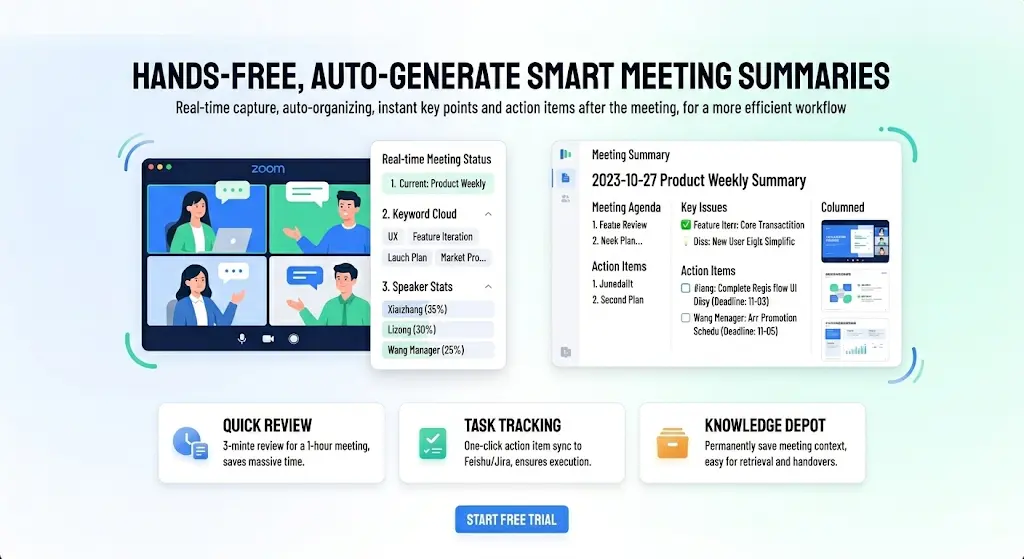
Best AI Note Taker for Zoom in 2026 — Auto Summary, Action Items & Smart Search
Compare the 6 best AI note takers for Zoom meetings. Get automatic transcription, summaries, and action items. See how they stack up on accuracy, features, and price.

How to Convert Video to Text with Visual Descriptions (2026 Guide)
In a world where 80% of internet traffic is video, text-only transcripts leave out half the story. This guide shows you how to use [Memories.ai](https://memories.ai/app) to convert video and audio into text that includes visual narratives, speaker recognition, and customized summaries.