
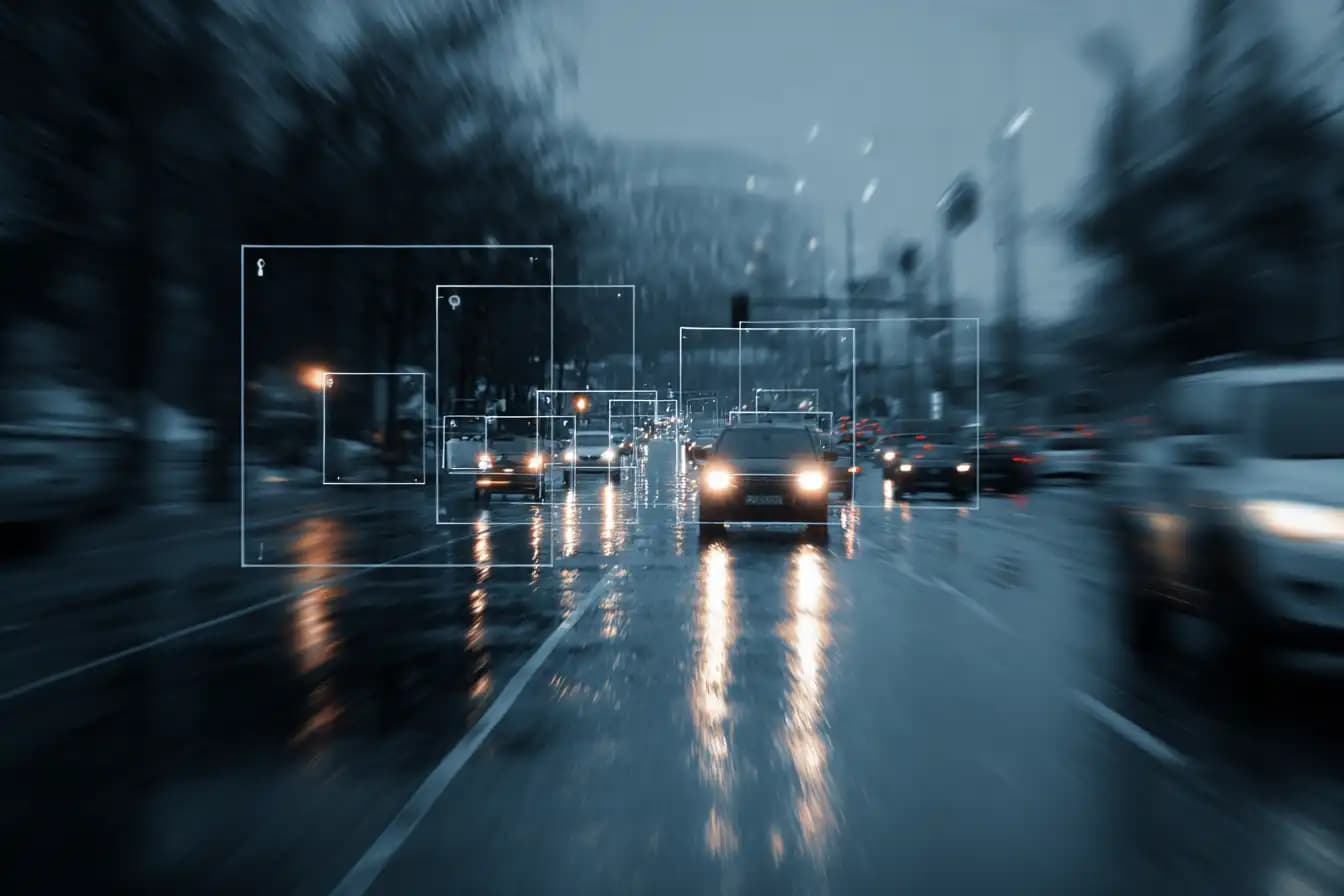
Mastering AI Video Analysis: Adapting to Shifting Light and Environments
In security, sports, and media, inconsistent lighting and changing environments often throw off object detection and analytics. This guide dives into how AI video analysis tackles these variations. We'll explore the core issues, introduce smart algorithms, and showcase practical preprocessing steps. You'll learn to conquer tricky lighting, implement powerful computer vision, build analytics that withstand weather and motion blur, and boost low-light performance. Plus, we'll show you how to seamlessly integrate Memories.ai's advanced API for enterprise-level deployment. We'll start by looking at the main lighting hurdles, then move on to adaptive processing, environmental resilience, low-light improvements, outdoor best practices, temporal adaptation metrics, and what's next in AI video analysis.
What Are the Biggest Hurdles for AI Video Analysis in Changing Light?
AI video analysis falters when brightness levels swing wildly, messing up feature extraction and leading to missed objects or false alarms. This happens because models trained in stable light conditions lose their grip on real-world video feeds, hurting accuracy where it counts. Understanding these challenges is key for businesses aiming for consistent performance, no matter the lighting.
Here are the main lighting issues AI systems face:
- Too much sun can overwhelm image sensors with blinding brightness.
- Deep shadows reduce contrast and hide crucial details.
- Extreme brightness differences can exceed what camera sensors can capture, leading to clipped highlights and lost detail.
- Artificial lights can cast unnatural colors, distorting how objects appear.
The Struggle of AI Video Analysis with Shifting Light
AI video analysis hits snags when pixel brightness fluctuates, causing feature extraction to fail, resulting in missed detections and false positives. Overexposure, underexposure, wide dynamic range shifts, and color casts from artificial lights are the primary culprits, demanding specialized solutions.
This source points out how poor lighting, including dim conditions and harsh contrasts, impacts video quality and complicates AI video analysis.
These problems require smart solutions to bring back consistent feature representation, paving the way for precise analysis.
How Do Lighting Changes Mess with AI Object Detection Accuracy?
Lighting variations blur the lines of features and textures, making bounding boxes less precise and increasing classification mistakes. When light fades, contrast drops, and AI filters can misinterpret shadowed areas. By improving exposure consistency, we can preserve shape and color information, allowing AI video analysis to keep its detection game strong, even when lighting gets wild.
What Environmental Factors Throw Off AI Video Analytics?
Things like rain, fog, and dust scatter light and obscure what the camera sees, directly blocking AI video analysis. Moisture distorts pixels and adds noise, triggering false alarms. Snow and wind-blown particles create more obstructions and motion artifacts, making real-time analysis tough in outdoor settings.
Here are the key external influences:
- Rain reduces visibility through refraction and reflections.
- Fog scatters light, lowering contrast.
- Snow creates bright, high-contrast areas that confuse AI models.
- Dust and smoke create a persistent haze.
How Environmental Factors Impact AI Video Analytics
Environmental elements like rain, fog, and dust get in the way of AI video analysis by scattering light and obscuring scene details. These factors introduce noise and reduce visibility, hindering real-time analytics in outdoor environments.
This source explains how extreme weather and airborne particles can degrade video quality, impacting AI video analytics performance.
Getting a handle on these variables is crucial before we even think about optimizing low-light performance, as environmental noise just adds to the lighting challenges.
Why Is Low-Light Performance So Important for AI Video Analysis?
Low-light performance is all about how well an AI system can pick out important details when the light levels drop below 10 lux. This is critical for nighttime surveillance and capturing events in dim conditions. Less light means more sensor noise and a lower signal-to-noise ratio (SNR), leading to fuzzy outlines and missed objects. Boosting low-light sensitivity ensures continuous, reliable analysis when natural or artificial light is scarce.
Here’s why adapting to low light matters:
- Nighttime security needs clear object separation in less than 5 lux.
- Filmmakers need to preserve detail in dimly lit sets for post-production.
- Sports broadcasts benefit from noise-free infrared capture under stadium lights.
Boosting Low-Light Video Quality with AI
To improve low-light object detection, we use preprocessing, retrain models on nighttime data, and add synthetic lighting to make features stand out. These methods boost detection confidence when ambient light is low.
This source touches on using super-resolution to sharpen details and cut down noise in low light, which fits perfectly with our discussion on low-light performance.
Achieving solid low-light analytics sets the stage for adaptive processing techniques that can adjust to dynamic scenes on the fly.
How Can AI Video Analysis Systems Adapt to Lighting Changes?
Adaptive AI video analysis uses techniques like exposure fusion, tone mapping, and histogram equalization to smooth out brightness shifts and keep features consistent. By integrating these computer vision solutions, systems can dynamically adjust pixel data, leading to more stable object recognition and fewer errors in varied lighting.
| Technique | How It Works | What It Does |
|---|---|---|
| Exposure Fusion | Combines multiple exposures into one HDR image | Keeps details sharp in both dark and bright areas |
| Adaptive Histogram | Rebalances the intensity distribution | Boosts contrast in darker areas |
| Tone Mapping | Compresses the range of brightness | Ensures consistent visual data for feature extractors |
These adaptive methods build a strong foundation for more advanced outdoor analytics and specialized algorithms designed for low-light conditions.
What Are the Top Computer Vision Solutions for Lighting Fluctuations?
Using Retinex-based algorithms and local contrast enhancement helps maintain natural colors while stabilizing pixel brightness. Retinex models break down images into illumination and reflectance components, allowing AI video analysis to focus on consistent reflectance patterns for object classification. These methods sharpen features and reduce false positives when brightness changes.
How Does Adaptive AI Video Processing Boost Outdoor Analytics?
Adaptive processing pipelines constantly monitor scene brightness, automatically tweaking exposure compensation and gamma correction to keep frames looking their best. By continuously measuring ambient light, AI video analysis updates its settings to handle shadows and glare instantly, improving object tracking in open spaces. This dynamic approach ensures uninterrupted analytics from sunrise to sunset.
Which Algorithms Make AI More Robust in Low Light?
Algorithms like adaptive Wiener filtering and deep convolutional denoising clean up sensor noise while preserving edge details in footage captured with minimal light. When combined with generative adversarial networks trained on dark scenes, these solutions can reconstruct lost features and sharpen outlines. Better robustness in dim conditions leads to more reliable detection and classification.
What Techniques Ensure AI Video Analytics Can Handle Environmental Factors?
Robust AI video analysis employs multi-scale filtering, weather-specific models, and dynamic thresholding to combat issues from rain, fog, and motion. These techniques fine-tune image preprocessing and model analysis under various environmental stresses, maintaining detection accuracy and cutting down on misclassifications.
| Technique | Key Parameter | Effect |
|---|---|---|
| Multi-scale Filtering | Kernel sizes | Removes rain streaks without blurring objects |
| Dehazing Models | Transmission maps | Restores contrast in foggy scenes |
| Motion-adaptive Thresholding | Optical flow vectors | Reduces artifacts from motion blur |
Applying these methods ensures AI video analysis remains dependable in a wide range of outdoor conditions.
How Does AI Deal with Weather and Outdoor Environmental Changes?
AI video analysis uses weather-aware models that tap into real-time sensor data—like humidity and light levels—to adjust preprocessing. By combining weather information with image data, systems can predict visibility drops and apply corrective filters ahead of time, keeping live feeds clear.
What Role Does Sensor Fusion Play in Environmental Adaptation?
Sensor fusion merges data from RGB cameras, infrared sensors, and LiDAR to create layered information that improves scene understanding in tough conditions. Infrared can see through smoke and fog using thermal signatures, while LiDAR maps depth to distinguish objects from background noise. This multi-sensor approach significantly boosts detection reliability in challenging environments.
How Are Noise and Motion Blur Tackled in Difficult Conditions?
AI video analysis uses temporal denoising and motion compensation algorithms that leverage frame-to-frame similarities to reduce noise and fix blur. Optical flow-based interpolation reconstructs sharp edges, while spatiotemporal filters remove temporary glitches. These methods keep object outlines clear and ensure consistent analysis, even in fast-moving scenes.
How to Boost AI Object Detection Performance in Low Light?
To improve object detection in low light, we use specialized preprocessing, retrain models on nighttime data, and add synthetic lighting to make features more visible. These combined strategies boost detection confidence when ambient light drops below critical levels.
What Preprocessing Methods Enhance Low-Light Video Quality?
Preprocessing steps like brightness scaling, gamma correction, and denoising amplify the signal and reduce noise in dark footage. Automated gamma curves adjust to the scene’s brightness, while non-local means denoising preserves textures. By restoring detail before analysis, AI video analysis maintains high detection rates even with minimal illumination.
How Do Deep Learning Models Adapt to Low Illumination?
Deep learning models adapt by using transfer learning on labeled low-light datasets and employing attention mechanisms that highlight dimly lit areas. Fine-tuning convolutional layers for low-contrast features and integrating illumination-aware loss functions make models more sensitive to subtle object cues, improving detection and classification.
What Are Practical Applications for Low-Light AI Video Analysis?
Low-light AI video analysis is essential for:
- Nighttime Security – Spots intruders in less than 5 lux without extra lights.
- Wildlife Monitoring – Tracks animals at night using infrared-enhanced feeds.
- Night Sports Broadcasting – Sharpens visuals under stadium lights.
These examples show how it can be deployed across security, conservation, and entertainment sectors.
What Are the Top Practices for Adaptive AI Video Processing Outdoors?
Adaptive outdoor analytics require constant calibration, dynamic region-of-interest selection, and edge computing to minimize delays. Systems should monitor environmental sensors, adjust settings in milliseconds, and process data on-device when network connections are unstable. This approach ensures continuous insights in remote or tough locations.
Top Practices for Adaptive AI Video Processing Outdoors
Adaptive outdoor analytics demand continuous calibration, dynamic ROI selection, and edge computing to cut down on latency. Systems need to monitor environmental sensors and adjust parameters in milliseconds to ensure uninterrupted insights in remote or harsh locations.
This source stresses the importance of high-level video processing within the camera itself for accurately detecting targets outdoors, aligning with our discussion on adaptive processing.
How Does Real-Time Lighting Adjustment Improve Video Analytics?
Real-time adjustment uses scene brightness histograms to instantly trigger exposure and contrast recalibration. By updating preprocessing settings frame by frame, AI video analysis maintains consistent feature quality, reducing missed detections during rapid light changes.
What Hardware and Software Solutions Support Outdoor AI Video?
Outdoor setups benefit from rugged edge servers, specialized low-light cameras, and FPGA-accelerated processing units that handle denoising and HDR fusion on-site. Combined with optimized inference engines and containerized AI models, these solutions deliver high performance with minimal delay in remote areas.
AI-Powered Video Surveillance for Outdoor Safety
AI-driven video surveillance systems combine advanced hardware with smart software for comprehensive monitoring and analysis in outdoor spaces. High-resolution cameras with night vision and weatherproofing are key components.
This source highlights how AI cameras can intelligently detect and classify objects, improving visibility in various conditions, which is relevant to our discussion on outdoor surveillance.
How to Balance Accuracy and Efficiency in Outdoor AI Systems?
Balancing accuracy and efficiency involves choosing lightweight model designs, removing unnecessary parameters, and using mixed-precision computing. Dynamic resolution scaling and region-based analysis reduce processing load while keeping detection sharp, enabling real-time analytics with limited resources.
How Do Environmental Changes Affect AI Video Analysis Accuracy Over Time?
Environmental conditions change daily and seasonally, gradually degrading model performance if adaptation mechanisms aren't in place. Continuous exposure to new lighting patterns, weather cycles, and landscape shifts can reduce accuracy unless monitoring and retraining processes are established.
What Are Common Environmental Variations That Impact AI Models?
AI models encounter variations like:
- Seasonal changes in foliage altering background textures.
- Daily cycles shifting color temperature.
- Urban development changing the scene’s structure.
These shifts introduce new data patterns, requiring adaptive learning strategies.
How Can AI Systems Learn and Adapt Continuously to New Conditions?
Continuous adaptation uses online learning, domain adaptation, and regular retraining with automatically labeled data. Techniques like self-supervised fine-tuning on recent footage allow models to adjust to changing environments without extensive manual labeling.
What Metrics Measure AI Video Analysis Robustness in Dynamic Environments?
Robustness is measured using:
- Detection Stability Index (DSI): Tracks consistency across lighting changes.
- Environmental Drift Rate (EDR): Monitors performance decline over time.
- True Positive Retention (TPR): Shows sustained recall under changing conditions.
These metrics guide model upkeep and retraining schedules for lasting accuracy.
What Future Trends Will Enhance AI Video Analysis in Challenging Conditions?
New innovations—like neuromorphic sensors, neural radiance fields, and federated learning—are set to revolutionize adaptive video analytics. By mimicking biological vision and enabling distributed model improvement, these trends will deliver richer, privacy-focused insights across extreme lighting and environmental conditions.
How Will Advances in Computer Vision Improve Lighting Adaptation?
Next-generation vision transformers and context-aware networks will offer superior brightness normalization by learning overall scene representations and dynamically adjusting feature extraction. These models will handle HDR frames natively, eliminating the need for separate exposure fusion steps.
What Emerging Technologies Support Robust Environmental AI Analytics?
Technologies like event-based cameras detect pixel changes asynchronously, reducing motion blur and improving low-light sensitivity. Quantum dot sensor arrays boost dynamic range, while edge AI accelerators with built-in denoising provide real-time processing in harsh conditions.
How Will AI Video Analysis Evolve for Smarter Outdoor Surveillance?
Future outdoor surveillance systems will integrate autonomous drones with adaptive video analytics, enabling mobile perimeter monitoring with in-flight exposure correction and weather-resistant analysis. Federated learning will sync models across fleets, ensuring collective intelligence that adapts to diverse environments.
The ongoing evolution of these trends is paving the way for AI video analysis that seamlessly adapts to any lighting and environmental challenge. Memories.ai is ready to empower businesses with scalable API integration, enabling developers to deploy robust analytics pipelines and stay ahead in dynamic real-world scenarios.
Read more

Best Meeting Transcription Software in 2026 (Tested & Compared)
We tested 8 meeting transcription tools head-to-head. Compare accuracy, AI summaries, pricing, and integrations to find the best fit for your team.

Best AI Note Taker for Zoom in 2026 — Auto Summary, Action Items & Smart Search
Compare the 6 best AI note takers for Zoom meetings. Get automatic transcription, summaries, and action items. See how they stack up on accuracy, features, and price.

How to Convert Video to Text with Visual Descriptions (2026 Guide)
In a world where 80% of internet traffic is video, text-only transcripts leave out half the story. This guide shows you how to use [Memories.ai](https://memories.ai/app) to convert video and audio into text that includes visual narratives, speaker recognition, and customized summaries.