
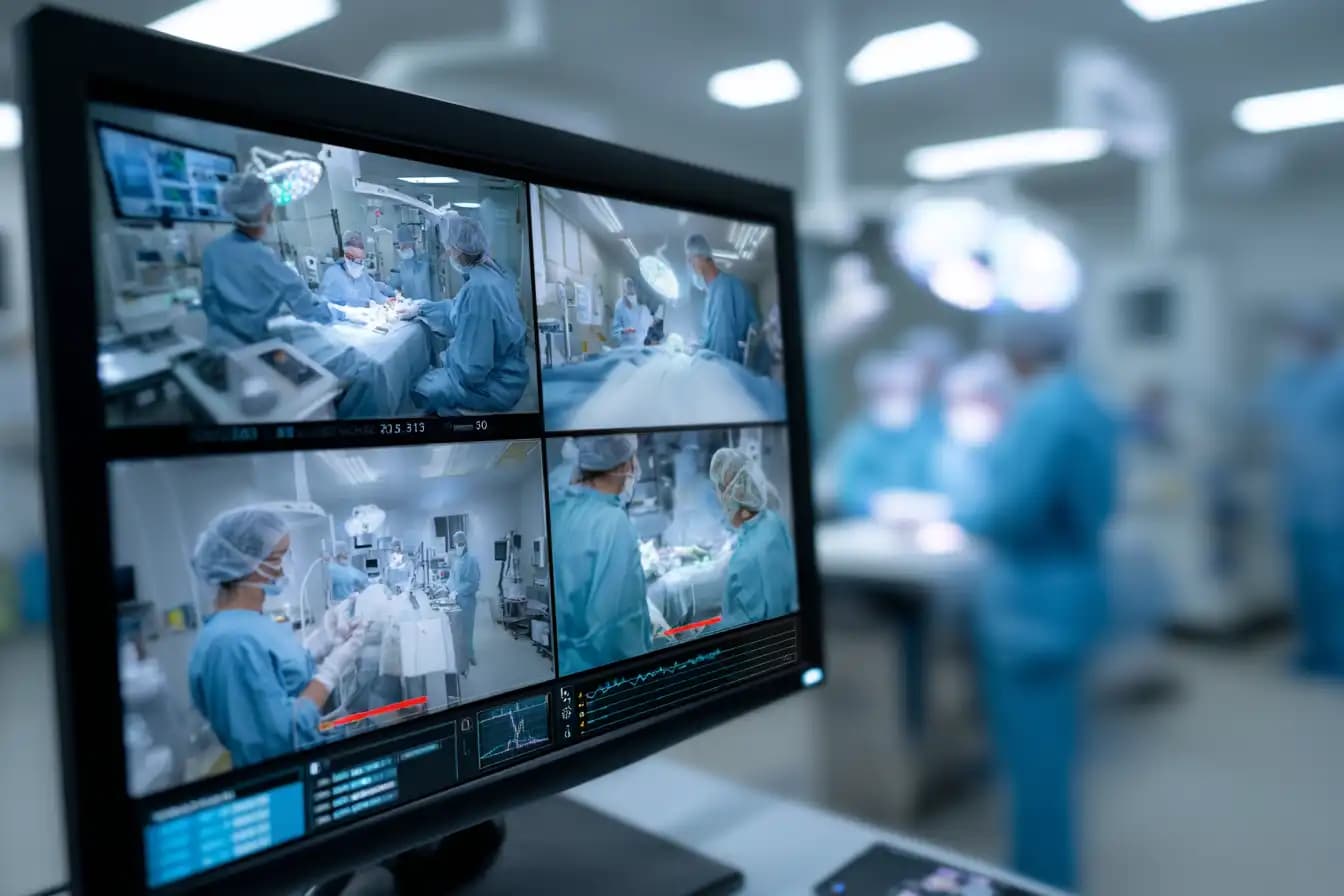
AI Video Applications in Healthcare: Revolutionizing Patient Care with Advanced Video Analytics
Artificial intelligence-powered video analytics is transforming clinical environments by offering continuous, automated oversight of patient behavior, surgical performance, and facility safety. As healthcare providers navigate pressures to elevate outcomes, trim expenses, and uphold compliance, AI-driven video platforms deliver real-time intelligence to pinpoint critical events, streamline operations, and tailor educational experiences. This article delves into seven crucial areas—patient monitoring, surgical training, elder care, clinical workflows, ethical considerations, future advancements, and ROI—to illustrate how AI video applications enhance safety, efficiency, and the patient journey, all while integrating scalable, API-first solutions for hospitals, clinics, and prosumers.
How Does AI Elevate Patient Monitoring and Safety in Healthcare?
AI video analytics merges computer vision, deep learning, and sensor fusion to provide constant observation of patient movements and physiological indicators, paving the way for proactive interventions. By meticulously analyzing every frame of live video, these systems can detect anomalies—such as falls or signs of distress—and promptly alert caregivers, significantly reducing response times and adverse incidents.
What Are Real-Time AI Fall Detection Systems and Their Advantages?
Real-time AI fall detection employs convolutional neural networks to identify changes in posture and unusual movement patterns, triggering immediate alerts to staff.
- Swift incident identification accelerates care delivery.
- Automated logging establishes verifiable safety records.
- Continuous learning refines detection accuracy over time.
AI in Fall Detection Systems
AI-enhanced fall detection systems utilize computer vision and deep learning to identify falls, thereby shortening response times and bolstering patient safety. These systems analyze video frames to detect irregularities, alerting caregivers within moments of an event.
These capabilities directly contribute to improved patient safety metrics and reduced liability by meticulously logging each event for clinical review, setting the stage for the integration of remote patient monitoring.
How Does Remote Patient Monitoring Utilize AI Video Analytics?
Remote patient monitoring harnesses live video feeds and edge-based AI models to track vital signs and activity patterns in home or telehealth environments.
- Key functionalities include estimating respiratory rates and analyzing movement trends.
- Predictive alerts notify healthcare providers of potentially critical patient deterioration.
- Secure cloud integration ensures data storage adheres to HIPAA standards.
This remote analysis extends care beyond the confines of hospital walls, facilitating early intervention and providing seamless support for clinical documentation.
In What Ways Does Behavioral Analysis Enhance Care for High-Risk Patients?
Behavioral analysis models categorize agitation, wandering, and sleep disturbances through the recognition of posture and facial expressions.
- Early identification of delirium helps prevent escalation of symptoms.
- Automated behavior logs inform the development of personalized therapy plans.
- Insights into medication adherence support informed clinical decision-making.
By detecting subtle shifts in behavior, AI elevates individualized care for patients in psychiatric and neurological care, connecting patient monitoring with advanced surgical training modules.
How Is AI Video Employed for Hospital Security and Patient Surveillance?
AI video systems monitor entrances, corridors, and medication storage areas to detect unauthorized access, unattended patients, or staff distress signals.
- Object detection identifies potential safety hazards (e.g., spills or blockages).
- Facial recognition manages access to restricted zones.
- Real-time video dashboards consolidate alerts for security personnel.
Integrating patient surveillance with clinical alerts establishes unified safety management, bridging patient care with facility operations.
How Is AI Video Revolutionizing Surgical Training and Education?
AI video applications analyze recorded and live surgical procedures to evaluate skill proficiency, standardize training programs, and provide data-driven feedback for both residents and experienced surgeons. Real-time guidance overlays critical anatomical markers and instrument paths to enhance precision.
AI in Surgical Training
AI is transforming surgical education by analyzing procedures to assess skill levels and deliver data-driven feedback. Real-time guidance overlays essential anatomical landmarks and instrument trajectories, thereby improving precision and patient outcomes.
Bilgic, Elif et al. “Artificial Intelligence in Surgical Education: Considerations for Interdisciplinary Collaborations.” Surgical innovation vol. 29,2 (2022): 137-138.
This citation supports the article's discussion on AI's role in surgical training and education.
What Are the Advantages of AI-Powered Surgical Skill Assessment Videos?
AI-powered skill assessment utilizes pose estimation and tool classification to evaluate hand-eye coordination, suture precision, and procedural efficiency.
- Objective metrics replace subjective performance evaluations.
- Automated progress reports expedite competency certification processes.
- Personalized coaching modules address identified areas for skill improvement.
These assessments foster continuous professional development and reduce training durations, laying the groundwork for enhancements in intraoperative guidance.
How Does Real-Time Intraoperative AI Guidance Improve Surgical Outcomes?
Real-time AI guidance provides augmented reality prompts for identifying blood vessels, delineating surgical margins, and optimizing instrument placement.
- Minimizes the risk of accidental tissue damage.
- Shortens operative times through more efficient workflows.
- Enhances trainee learning by visualizing expert techniques.
This guidance elevates procedural consistency and patient safety, linking surgical training with post-operative video review.
What Role Does Post-Operative Video Review Play in Clinical Feedback?
Post-operative review systems timestamp key procedural events, annotate any deviations from protocol, and generate performance dashboards for debriefing sessions.
- Structured feedback promotes reflective learning and skill refinement.
- Comparative analytics benchmark performance across different surgeons.
- Secure annotation tools ensure robust data governance.
Reviewing surgeries in this manner deepens understanding of best practices and prepares the way for generative AI simulations.
How Can Generative AI Create Personalized Medical Simulation Videos?
Generative AI pipelines synthesize patient-specific anatomy and varied scenarios into interactive simulation videos.
- Customized scenarios replicate complex medical conditions.
- Adaptive learning pathways adjust difficulty based on user performance.
- Integration with VR headsets enhances user immersion.
These simulations democratize surgical education and equip clinicians to handle rare or critical cases, reinforcing the surgical training continuum.
What Are the Key AI Video Solutions for Elderly Care and Assisted Living?
AI in Elderly Care
AI video platforms in senior care concentrate on fall prevention and behavioral monitoring, striking a balance between safety and personal dignity. Non-intrusive methods, such as silhouette extraction, preserve privacy while monitoring activity, ensuring safety insights without compromising individual dignity.
AI video platforms for senior care focus on preventing falls, monitoring behavior, and employing privacy-preserving surveillance, balancing safety with dignity. Continuous analysis of movement and environmental factors supports proactive interventions.
How Does AI Video Prevent Falls and Enhance Senior Safety?
Multimodal AI systems combine depth sensors and 2D cameras to predict potential balance loss and unstable gait patterns.
- Early warning alerts notify caregivers of high-risk behaviors.
- Automated floor mapping identifies potential hazard zones.
- Adaptive learning refines predictions for each resident.
Proactive fall prevention directly contributes to improved nursing home surveillance strategies, enhancing overall care outcomes.
What Are Non-Intrusive AI Video Monitoring Techniques for Elderly Behavior?
Non-intrusive methods utilize low-resolution thermal imaging and silhouette extraction to maintain privacy while monitoring activity.
- The absence of facial recognition ensures user anonymity.
- Behavior trend analysis detects wandering or agitation patterns.
- Rule-based alerts signal deviations from established routines.
These approaches provide safety insights without infringing on personal dignity, paving the way for privacy-preserving analytics.
How Is AI Enhancing Nursing Home Surveillance While Preserving Privacy?
AI filters mask faces and blur personal identifiers, concentrating solely on posture and motion data.
- Pseudonymized tracking maintains auditable records.
- Edge processing prevents raw footage from leaving the facility.
- Configurable privacy policies align with regional regulations.
This privacy-first surveillance ensures compliance and fosters resident trust in assisted living environments.
What Privacy-Preserving Methods Are Used in Senior Care Video Analytics?
Techniques such as homomorphic encryption and federated learning secure video data throughout the analysis process.
- Encrypted model training prevents exposure of raw data.
- Decentralized feature extraction limits the flow of sensitive information.
- Compliance modules enforce GDPR and HIPAA policies.
These safeguards are essential for ethical AI deployment and support broader integration into clinical workflows.
How Does AI Video Improve Clinical Workflow and Diagnostic Accuracy?
By automating video-based documentation, procedure logging, and image-driven diagnostics, AI video reduces manual tasks and accelerates diagnostic cycles in fields like endoscopy and pathology.
How Does AI Support Clinical Documentation Through Video Analysis?
AI automatically extracts procedure timestamps, instrument usage logs, and voice-to-text summaries from surgical videos.
- Structured reports integrate seamlessly with EHR systems.
- Time-series dashboards monitor resource utilization.
- Compliance checks verify adherence to established protocols.
Automated documentation frees up clinical staff to focus on patient-centered activities, boosting overall workflow efficiency.
What Are AI-Assisted Diagnostic Video Applications in Endoscopy and Pathology?
Deep learning models classify tissue abnormalities in endoscopic feeds and digitized slides, highlighting polyps or malignant cells in real time.
- Early lesion detection improves patient prognoses.
- Interactive annotations assist clinician review processes.
- Continuous learning ensures models are updated with new data.
These applications enhance diagnostic accuracy and reduce the need for repeat procedures, integrating smoothly with emergency medicine workflows.
How Does AI Optimize Emergency Medicine Workflow with Video Analytics?
AI video systems triage incoming emergency department patients by monitoring vital signs screens and staff actions, flagging critical cases for priority treatment.
- Queue management dashboards optimize resource allocation.
- Predictive alerts forecast potential patient deterioration.
- Integration with telemetry systems supports rapid response teams.
By aligning video insights with clinical protocols, AI streamlines emergency workflows and alleviates overcrowding.
What Is the Role of AI in Medical Imaging Video Interpretation?
AI analyzes dynamic imaging modalities, such as echocardiography and fluoroscopy, to quantify functional metrics like ejection fraction and blood flow velocities.
- Automated measurements expedite report generation.
- Abnormality detection highlights areas requiring further examination.
- Standardized reporting improves consistency among different observers.
These interpretive tools integrate directly into radiology and cardiology workflows, reinforcing diagnostic precision.
What Ethical and Technical Considerations Are Crucial for AI Video in Healthcare?
Implementing AI video solutions necessitates robust data security, bias mitigation, and adherence to healthcare regulations to maintain trust and effectiveness.
How Is Data Privacy and Security Ensured in Healthcare AI Video Solutions?
Advanced encryption, role-based access controls, and audit logging safeguard video streams and associated metadata.
- End-to-end TLS/SSL encryption protects data in transit.
- At-rest encryption secures data stored in the cloud and on edge devices.
- Access audits prevent unauthorized viewing of sensitive information.
These security layers are fundamental for regulatory compliance and building patient confidence.
What Strategies Mitigate Bias in AI Video Algorithms?
Diverse training datasets, fairness-aware loss functions, and continuous performance monitoring help reduce demographic or equipment-related biases.
- Synthetic data augmentation addresses underrepresented groups.
- Model interpretability tools trace decision-making pathways.
- External audits validate fairness metrics.
Bias mitigation enhances algorithmic accuracy across diverse patient populations, fostering trust in AI-driven healthcare.
How Do Regulatory Compliance Standards Affect AI Video Deployment?
Adherence to HIPAA, GDPR, and FDA medical device guidelines governs data management, algorithm validation, and change management protocols.
- Pre-market submissions document safety and efficacy.
- Clinical trials validate real-world performance.
- Continuous monitoring ensures post-deployment conformity.
Following these standards is essential for scalable and lawful integration into healthcare systems.
What Developer Resources and API Integrations Support Healthcare AI Video?
Comprehensive SDKs, RESTful APIs, and developer portals facilitate seamless integration with EHR platforms, PACS systems, and mobile applications.
- Authentication workflows support OAuth2 and JWT tokens.
- Webhooks and event streams provide real-time notifications.
- Detailed sample code accelerates the onboarding process.
These resources empower AI developers to extend and customize video analytics for enterprise and prosumer applications.
What Are the Future Trends and Innovations in AI Video Applications for Healthcare?
Emerging technologies like transformer-based models, edge AI chips, and federated architectures will drive the next generation of video analytics, making them faster, more accurate, and more secure.
How Will Generative AI Personalize Patient Education Through Video?
Generative adversarial networks will create scenario-based tutorials and condition-specific animations tailored to a patient’s individual medical profile.
- Automated voice-overs explain procedures in simple terms.
- Customizable avatars enhance user engagement.
- Real-time Q&A modules adapt content based on user inquiries.
This personalized approach extends the value of patient education materials across telehealth and in-clinic settings.
What Advances Are Expected in Disease-Specific Video Monitoring?
Specialized models will quantify biomarkers such as tremor frequency in Parkinson's disease or gait asymmetry in stroke rehabilitation using detailed motion analysis.
- Continuous monitoring tracks progression markers.
- Predictive models inform therapeutic adjustments.
- Longitudinal data supports clinical research initiatives.
These disease-specific applications deepen clinical insights and enable precision medicine.
How Will AI Video Integration Expand Across Healthcare Ecosystems?
Interoperable standards like HL7 FHIR and DICOMweb will allow video analytics to integrate with laboratory, genomic, and wearable device data into unified care platforms.
- Cross-platform dashboards provide comprehensive patient views.
- API marketplaces encourage innovation from third-party applications.
- Blockchain-based audit trails ensure data integrity.
Ecosystem expansion amplifies the impact of AI video tools on patient outcomes and resource optimization.
What Are the Proven Benefits and ROI of AI Video Solutions in Healthcare Settings?
Hospitals and clinics implementing AI video analytics report tangible improvements in safety, efficiency, and financial performance, often recouping costs within months through reduced adverse events and streamlined operations.
| Use Case | Key Metric Impact | ROI Evidence |
|---|---|---|
| Fall Detection | Up to 35% reduction in falls | Approximately $200K in annual liability cost savings |
| Surgical Skill Assessment | 20-25% faster training completion | $150K in avoided training costs |
| Remote Patient Monitoring | 25-30% fewer readmissions | Over $1M saved on inpatient stays |
| Emergency Dept Triage Alerts | 10-15% faster triage times | Improved revenue through increased patient throughput |
How Do AI Video Tools Improve Patient Outcomes and Safety Metrics?
AI video tools identify safety events—such as falls or code blues—within seconds, reducing adverse event rates by up to 35-40% and cutting critical response times by nearly half.
What Operational Efficiencies Result from AI Video Workflow Automation?
Automated video documentation and analytics save clinical staff an average of 2–4 hours daily, leading to enhanced staff satisfaction and the reallocation of labor to patient-facing responsibilities.
Which Case Studies Demonstrate Successful AI Video Implementation?
Numerous healthcare systems have documented successful pilot programs:
- A major academic medical center reduced surgical complications by approximately 10-12%.
- A regional senior living network decreased fall-related hospital transfers by around 25-30%.
These examples underscore the versatility and impact of deploying AI video across various care settings.
How Can Healthcare Providers Measure ROI from AI Video Technologies?
Providers calculate ROI by comparing baseline safety and labor expenses against post-implementation metrics—tracking reductions in adverse events, time savings, and reimbursement gains—to quantify net financial and clinical advantages.
Transforming patient care with AI video analytics necessitates selecting solutions that deliver real-time insights, robust security, and seamless integration. As platforms advance with generative AI and interoperability standards, healthcare organizations are poised to benefit from unparalleled levels of safety, efficiency, and personalized care.
Read more

Best Meeting Transcription Software in 2026 (Tested & Compared)
We tested 8 meeting transcription tools head-to-head. Compare accuracy, AI summaries, pricing, and integrations to find the best fit for your team.
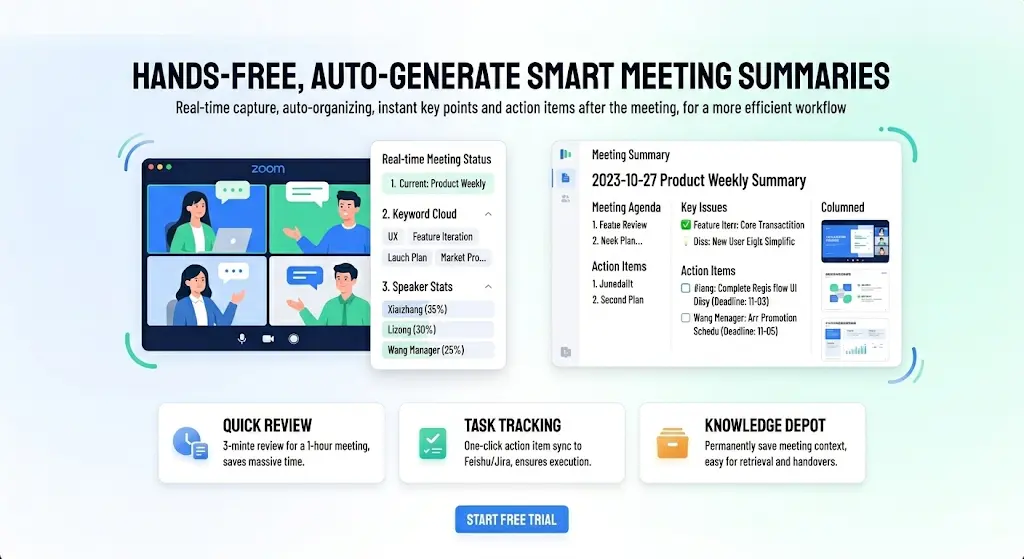
Best AI Note Taker for Zoom in 2026 — Auto Summary, Action Items & Smart Search
Compare the 6 best AI note takers for Zoom meetings. Get automatic transcription, summaries, and action items. See how they stack up on accuracy, features, and price.

How to Convert Video to Text with Visual Descriptions (2026 Guide)
In a world where 80% of internet traffic is video, text-only transcripts leave out half the story. This guide shows you how to use [Memories.ai](https://memories.ai/app) to convert video and audio into text that includes visual narratives, speaker recognition, and customized summaries.