

AI Video Tech: Unlocking Deeper Insights with Machine Learning
Harnessing machine learning for video processing, powered by computer vision and neural networks, allows us to extract valuable metadata, automate content understanding, and deliver actionable insights. This boosts security, streamlines media production, and revolutionizes marketing analytics. In 2023, the global AI video analytics market hit $6.1 billion and is set to soar past $30.8 billion by 2030, growing at a 26.1% CAGR, fueled by the demand for real-time monitoring, smart search, and creative content generation.
AI Video Analytics Market Momentum
The AI video analytics market was valued at $6.1 billion in 2023 and is projected to exceed $30.8 billion by 2030, marking a substantial compound annual growth rate (CAGR) of 26.1%. This surge is driven by the escalating need for real-time monitoring, intelligent search capabilities, and the creation of generative content.
What is Machine Learning for Video Processing and How Does It Work?
Machine learning for video processing applies sophisticated statistical models to sequences of frames, enabling automated tasks like object detection, action recognition, and content summarization. By training on annotated video datasets, both supervised and unsupervised algorithms learn visual patterns, transforming raw pixels into structured, meaningful insights.
Machine learning for video processing involves three key stages:
- Data Ingestion and Pre-processing: Frames are decoded, resized, and normalized to prepare them for algorithmic processing.
- Model Training and Optimization: Convolutional neural networks (CNNs), recurrent architectures, or transformer-based models are trained to identify entities and events accurately.
- Inference and Post-processing: Predictions are gathered, refined, and combined to generate metadata, alerts, or summaries.
This comprehensive pipeline significantly cuts down manual review time and scales video analytics across a wide array of applications, paving the way for specialized techniques like computer vision and deep learning to unlock even deeper insights.
What Are the Core Machine Learning Techniques Used in Video Analysis?
Key machine learning techniques for video analysis include supervised learning for classification, unsupervised learning for clustering, and reinforcement learning for adaptive event detection.
- Supervised Learning: Trains models like CNNs on labeled frames to precisely identify objects and activities.
- Unsupervised Learning: Utilizes autoencoders or clustering algorithms to uncover patterns such as scene changes or anomalies.
- Reinforcement Learning: Employs reward-based strategies for tasks like active camera tracking or dynamic framing adjustments.
Machine Learning Techniques in Video Analysis
Machine learning for video analysis leverages various techniques, including supervised learning for classification tasks, unsupervised learning for pattern discovery, and reinforcement learning for adaptive event detection. These methods are combined to automate complex video tasks, leading to faster and more accurate content understanding.
How Does Computer Vision Enable Video Understanding?
Computer vision empowers video understanding by translating raw pixels into sophisticated high-level representations, such as bounding boxes, semantic segmentations, and depth maps. Through feature extraction layers within CNNs, computer vision models effectively detect objects, classify scenes, and track motion across frames. This capability is fundamental to use cases like facial recognition, vehicle detection, and behavior analysis, which directly support business applications ranging from surveillance to audience measurement.
By structuring unstructured video data into distinct, manageable entities, computer vision lays the groundwork for subsequent deep learning models to deliver context-aware insights and automated decision support.
What Role Does Deep Learning Play in Video Insights?
Deep learning plays a pivotal role in extracting video insights by employing multilayer neural networks to learn hierarchical representations of visual information. Architectures such as:
- 3D CNNs: Capture spatio-temporal features essential for accurate action recognition.
- Recurrent Neural Networks (RNNs) and LSTMs: Model temporal dependencies across frames, crucial for predicting events.
- Vision Transformers: Utilize self-attention mechanisms to grasp long-range video context effectively.
Through deep learning, video analysis systems achieve human-level performance in tasks like speech-to-text transcription, emotion recognition, and automated editing, enabling richer metadata and more sophisticated content generation.
How Is Real-Time Video Analytics Achieved with Machine Learning?
Real-time video analytics is achieved by deploying optimized inference engines either at the edge or in the cloud, utilizing model quantization and hardware acceleration to process streams as they arrive.
Typical architectures incorporate:
- Edge Nodes: Equipped with GPUs/TPUs for ultra-low-latency inference.
- Message Queues: Such as Kafka, used to buffer and distribute frames efficiently.
- Microservices: Enabling parallel processing for detection, classification, and summarization tasks.
- Streaming Frameworks: Like Apache Flink, used to aggregate and post-process results seamlessly.
This robust architecture ensures sub-second response times for critical applications like security alerts, live sports analytics, and interactive marketing displays, providing continuous insights without manual intervention.
Edge AI for Real-Time Video Analytics
Edge AI is indispensable for real-time video analytics, facilitating low-latency processing by deploying optimized inference engines directly at the edge. This approach involves utilizing edge nodes with GPUs/TPUs, message queues, microservices, and streaming frameworks to guarantee sub-second response times across diverse applications.
Intel, Edge AI: Transforming Industries with Real-Time Insights (2024)
This resource offers valuable insights into the architecture and benefits of edge AI within the realm of video analytics, as detailed in this article.
Which Enterprise AI Video Solutions Drive Business Value?
Enterprise AI video solutions deliver significant value by reducing risk, enhancing operational efficiency, and enabling data-driven decision-making across key sectors like security, media production, marketing, and sports.
Implementing AI video technologies can slash manual review workloads by up to 80%, accelerate content delivery pipelines, and uncover hidden insights that drive revenue growth and ensure compliance.
| Enterprise segment | AI capability | Business impact |
|---|---|---|
| Security & surveillance | Real-time object & anomaly detection | Reduces false alarms by 60% and strengthens perimeter security |
| Media & production | Automated editing & metadata tagging | Shortens post-production cycles by 50% |
| Video marketing & advertising | Audience segmentation & sentiment analysis | Boosts targeting precision by 35% and ad ROI by 20% |
| Sports analytics | Player tracking & performance metrics | Enhances tactical insights and fan engagement by 40% |
These enterprise-grade solutions highlight how machine learning for video processing delivers measurable ROI and establishes a strong foundation for prosumer-level innovation.
How Does AI Enhance Security and Surveillance Video?
AI significantly enhances security and surveillance video by automatically detecting unauthorized access, tracking intruders, and flagging suspicious activities. By integrating object detection, facial recognition, and anomaly detection models, AI systems generate precise alerts, reduce operator fatigue, and improve incident response times, thereby strengthening perimeter protection and ensuring compliance with safety regulations.
What Are AI Applications in Media Production and Workflow Optimization?
AI applications in media production span automated scene detection, enriched metadata, and personalized content recommendations. Natural language processing (NLP) transcribes dialogue, while vision models tag visual elements for searchable archives. These AI capabilities accelerate editing, streamline version control, and enable dynamic personalization, transforming traditional workflows into agile, data-driven pipelines.
How Is AI Used for Video Marketing and Advertising Insights?
AI for video marketing extracts crucial viewer engagement metrics, sentiment scores, and demographic data to optimize ad placements and creative strategies. Computer vision identifies the effectiveness of product placements, while predictive analytics recommends the best distribution channels. Marketers leverage these insights to refine targeting, boost conversion rates, and tailor content to audience preferences in real time.
What Benefits Does AI Bring to Sports Performance Analysis?
AI delivers advanced benefits to sports performance analysis by meticulously tracking player movements, quantifying workloads, and modeling play strategies. Pose estimation and event recognition technologies can detect injuries in real time and assess fatigue levels. Coaches utilize these insights to refine training regimens, optimize tactics, and elevate athlete performance metrics, ultimately driving competitive advantage both on and off the field.
How Do Prosumer AI Video Tools Empower Creators and Professionals?
Prosumer AI video tools democratize advanced capabilities—such as automated editing, intelligent summarization, and high-quality upscaling—empowering independent creators, students, and small production teams to achieve professional-grade results.
What AI-Powered Video Editing Tools Are Available for Creators?
Leading AI-powered video editing tools offer cutting-edge features like automatic cut detection, style transfer filters, and speech-driven clip compilation. These tools:
- Automatically assemble highlight reels based on key emotional moments.
- Apply cinematic color grading using neural style algorithms.
- Generate accurate subtitles and closed captions with advanced natural language models.
Creators can experience up to 70% faster editing cycles and achieve higher audience retention by leveraging these intelligent AI assistants.
How Can Students and Indie Filmmakers Use AI for Video Projects?
Students and indie filmmakers can leverage AI for generating storyboards, creating budget-friendly visual effects, and automating sound design. For instance, generative AI can synthesize realistic background scenes, while AI audio mixers expertly balance soundtracks. These affordably scaled capabilities enable academic projects and low-budget films to compete with professional productions and refine storytelling techniques.
What Features Support Professional Video Content Creation with AI?
Professional video content creation is significantly enhanced by features such as collaborative cloud editing, API-driven asset management, and script-to-screen automation. Platforms seamlessly integrate with digital asset management (DAM) systems, allowing teams to tag, retrieve, and iterate on footage collaboratively. Enhanced metadata and search functionalities enable swift content repurposing across multiple channels.
How Does AI Video Summarization and Upscaling Benefit Prosumers?
AI video summarization algorithms efficiently condense hours of footage into concise clips by identifying key events and dialogue snippets. Combined with super-resolution upscaling, prosumers can transform low-quality source material into broadcast-ready 4K video. This powerful dual capability empowers independent creators to produce high-impact content without the need for extensive hardware investments.
| Tool category | Key feature | Creative benefit |
|---|---|---|
| Auto-editing AI | Scene cut detection | Accelerates rough cuts and highlight reel creation |
| Generative filters | Style transfer | Transforms footage with cinematic and artistic effects |
| Summarization engines | Key event extraction | Condenses raw video into shareable highlights |
| Super-resolution AI | Upscaling to 4K | Elevates low-resolution clips to professional quality |
By harnessing these prosumer tools, creators achieve polished results and can dedicate more focus to storytelling, paving the way for deeper developer customization.
How Can Developers Integrate AI Video APIs and Build Custom Models?
Developers can integrate AI video APIs to embed automated analytics and content generation directly into their applications, utilizing SDKs and microservices to expand platform capabilities.
What Are the Steps to Integrate AI Video APIs Effectively?
Integrating AI video APIs effectively involves several key steps:
- Authentication Setup: Securely manage API keys and common OAuth or token-based access.
- Endpoint Selection: Choose the appropriate endpoints for specific tasks like object detection, transcription, or summarization.
- Payload Preparation: Format video streams or frame batches precisely according to the API schema.
- Response Handling: Parse JSON results and map metadata accurately to application data models.
- Error Handling & Scaling: Implement robust retry logic and auto-scale serverless functions to manage high throughput efficiently.
Adhering to these steps ensures reliable, secure, and scalable integration of machine learning for video processing into both enterprise and prosumer applications.
How Can Custom Machine Learning Models Be Created for Video?
Custom machine learning models for video are developed through a structured process:
- Data Collection & Annotation: Gather domain-specific footage and meticulously label key entities or events.
- Model Selection: Choose suitable base architectures (e.g., YOLO, ResNet, ViT) and fine-tune them on the annotated data.
- Training & Validation: Train models using GPUs/TPUs, optimize hyperparameters, and validate performance on hold-out datasets.
- Deployment & Monitoring: Containerize models using Docker or TensorFlow Serving, deploy them at the edge or in the cloud, and monitor inference metrics for any drift.
This comprehensive pipeline empowers developers to tailor video analytics models to unique use cases, such as custom object recognition or specialized scene analysis.
What Ethical Considerations Should Guide AI Video Development?
Ethical AI video development requires a strong commitment to privacy protection, bias mitigation, and transparent data governance. Developers should:
- Anonymize personally identifiable information (PII) within training datasets.
- Rigorously evaluate models for potential demographic and environmental biases.
- Implement clear user consent mechanisms and maintain comprehensive audit logs.
- Establish human-in-the-loop review processes for sensitive use cases.
Integrating these practices ensures responsible innovation and fosters trust among users and regulatory bodies.
What Are the Emerging Trends and Future Directions in AI Video Technologies?
Emerging trends in AI video technologies include generative content creation, widespread edge AI deployment, and immersive analytics, all of which are reshaping how organizations capture and leverage video insights.
How Is Generative AI Transforming Video Content Creation?
Generative AI is revolutionizing video creation by synthesizing realistic scenes, enabling text-to-video generation, and automating voice-over narration with natural-sounding speech models. This transformation empowers marketers and storytellers to rapidly prototype content, deliver personalized ads at scale, and remix existing footage with minimal manual effort.
What Is the Impact of Edge AI on Real-Time Video Analytics?
Edge AI shifts inference processing closer to cameras and IoT devices, significantly reducing latency and bandwidth consumption. By running lightweight models on edge processors, organizations can achieve detection times under 100 milliseconds for critical applications like traffic monitoring and factory safety. This evolution expands real-time analytics capabilities into remote and bandwidth-constrained environments.
How Will AI Video Insights Shape Industry Innovations?
AI video insights are poised to drive industry innovations by enabling predictive maintenance in manufacturing, creating immersive retail experiences with virtual try-ons, and advancing telemedicine diagnostics through automated gesture and expression analysis. As models become more explainable and modular, cross-industry collaboration will accelerate the development of novel applications that integrate vision, speech, and sensor data into holistic decision-making engines.
What Are the Key Benefits and ROI of AI Video Analytics for Enterprises and Prosumers?
AI video analytics delivers tangible returns by reducing manual labor, improving decision accuracy, and unlocking new revenue streams through data-driven personalization.
How Does AI Improve Operational Efficiency and Security?
AI enhances operational efficiency by automating repetitive monitoring tasks and bolstering security through precise anomaly detection. Enterprises report up to a 70% reduction in monitoring costs and a 50% decrease in incident response times when deploying AI-driven surveillance, directly impacting bottom-line performance and risk management.
What Marketing and Engagement Gains Result from AI Video Insights?
AI video insights significantly boost marketing engagement by identifying viewer sentiment, optimizing creative elements, and recommending targeted distribution strategies. Brands leveraging these analytics experience up to 30% higher click-through rates, improved ad recall, and deeper audience personalization that drives substantial conversion uplifts.
How Do Prosumers Achieve Creative Empowerment with AI Tools?
Prosumers gain creative empowerment by automating editing workflows, generating storyboard prototypes, and transforming raw footage into shareable summaries. These efficiency gains free up valuable time for experimentation and storytelling, allowing independent creators to concentrate on innovation rather than manual production tasks.
How Does memories.ai Lead Innovation in AI Video Technologies?
memories.ai offers a comprehensive end-to-end AI video platform that unifies analysis, generative workflows, and developer APIs, democratizing advanced video intelligence for both enterprises and prosumers.
What Unique Features Does memories.ai Offer in AI Video Platforms?
memories.ai distinguishes itself by providing:
- Unified Analytics & Generation: Seamless transitions between understanding content and enhancing it through generative capabilities.
- Custom Model Marketplace: Access to pre-trained and fine-tunable video models tailored for niche applications.
- Real-Time Edge SDK: Lightweight inference libraries designed for efficient on-device deployment.
- Collaborative Workspaces: Cloud-based editing and annotation tools that scale effortlessly with team size.
These distinctive capabilities position memories.ai as a central hub for AI video innovation.
How Can Users Get Started with memories.ai Solutions and Partnerships?
Organizations and creators can easily get started by signing up on the memories.ai website, requesting a complimentary trial of the AI video platform, or exploring partnership programs that offer joint R&D, co-branding opportunities, and enterprise integration support. Early adopters benefit from hands-on onboarding and priority access to new feature releases.
What Developer Resources and Support Does memories.ai Provide?
memories.ai offers extensive developer resources, including:
- Sample Code Repositories: Hosted on GitHub, demonstrating practical integration patterns.
- Technical Documentation: Covering schema definitions, rate limits, and best practices.
- Community Forum & Dedicated Support: Channels for troubleshooting and knowledge sharing.
These resources empower developers to build custom video intelligence solutions rapidly and responsibly.
By embracing machine learning for video processing, organizations and creators unlock unprecedented levels of automation, insight, and creative freedom. memories.ai’s integrated platform, robust developer tools, and forward-thinking innovation roadmap ensure that every video asset becomes a powerful catalyst for action and growth. Discover memories.ai today to transform your video workflows and future-proof your content strategy.
Read more

Best Meeting Transcription Software in 2026 (Tested & Compared)
We tested 8 meeting transcription tools head-to-head. Compare accuracy, AI summaries, pricing, and integrations to find the best fit for your team.
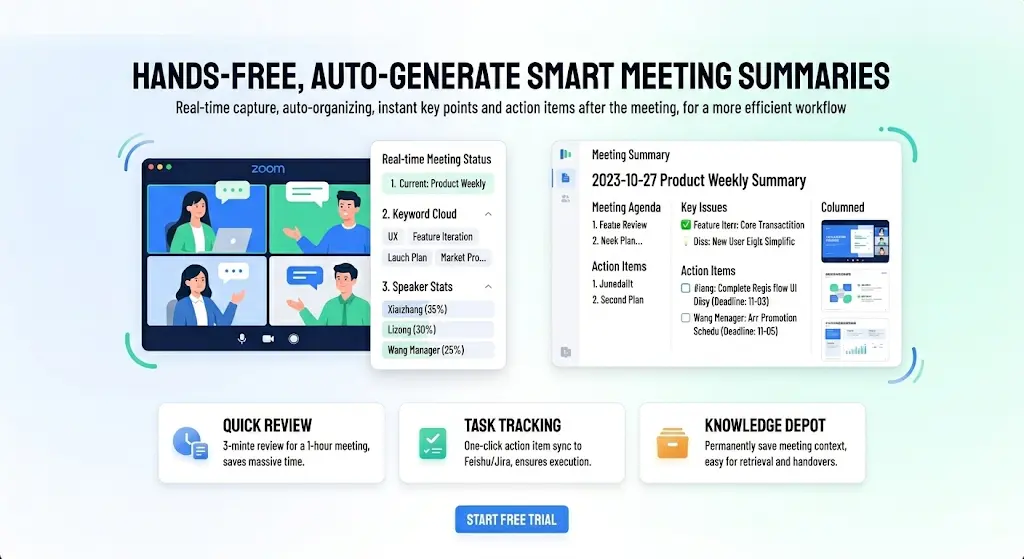
Best AI Note Taker for Zoom in 2026 — Auto Summary, Action Items & Smart Search
Compare the 6 best AI note takers for Zoom meetings. Get automatic transcription, summaries, and action items. See how they stack up on accuracy, features, and price.

How to Convert Video to Text with Visual Descriptions (2026 Guide)
In a world where 80% of internet traffic is video, text-only transcripts leave out half the story. This guide shows you how to use [Memories.ai](https://memories.ai/app) to convert video and audio into text that includes visual narratives, speaker recognition, and customized summaries.