

Unlock Your Content's Potential: AI Video Analysis Tools for Every Visionary
AI video analysis tools are revolutionizing how organizations and individual creators extract value from hours of footage by transforming unstructured video into indexed, searchable, and actionable insights. Enterprises across security, media, marketing, and sports workflows now rely on advanced computer vision, machine learning, and semantic search to drive decision-making and maximize content ROI. This article defines core AI video analysis concepts, explores industry benefits, highlights Memories.ai's leading platform features, guides prosumer use, outlines implementation best practices, and forecasts future innovations in video intelligence.
What is AI Video Analysis and How Does It Elevate Your Content Strategy?
AI video analysis applies artificial intelligence algorithms to detect objects, recognize speech, classify scenes, and extract metadata from video files to accelerate content discovery and strategic planning. By automating indexing and insight generation, teams can focus on creative and business outcomes rather than manual review. For example, marketing teams leverage scene detection to identify high-impact moments for social clips, boosting engagement and reducing edit cycles.
What Technologies Power AI Video Analysis Tools?
AI video analysis tools combine multiple AI subfields to interpret visual and auditory data:
- Computer Vision processes pixel patterns to detect objects, track movement, and segment scenes.
- Machine Learning trains models on labeled video datasets to generalize recognition across new footage.
- Natural Language Processing transcribes and semantically parses speech and on-screen text for keyword search.
- Deep Learning Architectures such as convolutional and transformer networks optimize feature extraction and context understanding.
These technologies work in tandem to deliver multimodal analysis, laying the groundwork for semantic retrieval and real-time intelligence.
How Does Semantic Video Search Improve Video Content Retrieval?
Semantic video search enables users to query video libraries using natural language and receive context-aware results. It maps query terms to video segments based on meaning rather than exact keyword matches.
“Customer testimonial”
NLP extracts sentiment and speaker intent
Pinpoints enthusiastic endorsements
“Goal celebration”
Object detection and action recognition
Finds dynamic sports highlights
“Product demo voice”
Audio embedding plus keyword alignment
Accelerates creative asset repurposing
By encoding video and text jointly, this approach surfaces relevant clips even when exact terms differ, enabling faster editorial workflows and data-driven content planning.
Why Is AI Video Analysis Critical for Modern Content Strategies?
AI video analysis enhances content strategy by improving efficiency, personalization, and performance measurement. It automates metadata generation, supports A/B testing through key moment identification, and drives targeted distribution based on audience insights. As enterprises and creators compete for attention, these tools elevate storytelling by focusing human resources on ideation rather than manual cataloging.
How Do AI Video Analysis Tools Benefit Enterprises Across Industries?
AI video analysis delivers tailored advantages for security, media production, marketing, and sports organizations by extracting actionable intelligence from vast footage repositories.
How Does AI Improve Security and Surveillance Through Video Analytics?
In security and surveillance, AI video analysis detects anomalies, recognizes faces, and triggers real-time alerts when defined behaviors occur. This capability reduces incident response times by up to 50 percent and enhances situational awareness in crowded or high-risk environments.
AI in Security and Surveillance
AI-powered video analysis significantly improves security and surveillance by detecting anomalies and recognizing faces, leading to faster incident response times and enhanced situational awareness. These systems can reduce response times by up to 50% in high-risk environments.
What Are the Advantages of AI Video Analysis in Media and Production?
Media and production teams accelerate workflows through automated scene tagging, shot-list generation, and transcript synchronization. Editors save hours by locating specific take types or on-screen dialogue, while producers gain comprehensive content summaries for client reviews and compliance checks.
How Can AI Video Insights Optimize Marketing and Advertising Strategies?
Marketing teams leverage AI-generated viewer engagement metrics, sentiment analysis, and demographic inference to refine campaign messaging. By identifying high-performing segments and repurposing B-roll highlights, they achieve up to 20 percent higher click-through rates and more informed content calendars.
AI in Marketing and Advertising
Marketing teams leverage AI to analyze viewer engagement metrics, sentiment, and demographics to refine campaign messaging. This data-driven approach can lead to a 20% increase in click-through rates and more informed content strategies.
What Role Does AI Play in Sports Analytics and Performance Review?
Sports organizations use AI to track player movements, analyze tactics, and produce automated highlight reels. Coaches gain precise performance metrics—such as speed, positioning, and event frequency—enabling data-driven training plans and enhanced fan engagement through instant replay clips.
What Features Make Memories.ai a Leading AI Video Analysis Platform?
Memories.ai distinguishes itself with a visual memory layer, unlimited context indexing, and real-time AI insights that surpass conventional batch processing tools.
How Does Multimodal Encoding Enable Deeper Video Understanding?
Memories.ai’s multimodal encoding ingests video frames, audio tracks, and on-screen text to build unified embeddings that represent scenes holistically. This architecture captures visual context, speaker tone, and dialogue content in a single vector space, enabling richer search and analysis.
What Are the Benefits of AI-Powered Semantic Search and Content Retrieval?
Semantic search on Memories.ai uses LLM-driven embeddings to interpret query intent, retrieve key moments, and surface related segments across long video archives. Users locate product highlights or compliance-critical scenes within seconds, eliminating manual scrubbing and simplifying collaboration.
How Does Real-Time Video Intelligence Enhance Decision-Making?
Real-time analytics continuously process live streams for event detection, sentiment shifts, and scene changes. Security teams receive instant alerts for unauthorized access, while marketing managers monitor live campaign activations to adjust messaging dynamically based on audience response.
What API and Integration Options Support Developer Innovation?
Memories.ai offers RESTful API endpoints for video indexing, semantic search, and custom model deployment. Developers can integrate video intelligence into existing applications, build chatbots that answer video-related queries, or train domain-specific models using proprietary data pipelines.
How Can Prosumers Leverage AI Video Analysis Tools for Content Creation?
Prosumers—including creators, students, and marketers—gain competitive advantages by automating editing, enriching learning materials, and optimizing campaign outputs.
What AI Tools Help Content Creators Optimize Video Projects?
Creators use scene detection and automatic cut suggestions to streamline rough cuts, while emotion analysis flags engaging segments for social teasers. Integration with popular editing suites accelerates the assembly of storyboards and promotional clips.
How Do Students and Educators Use AI Video Analysis for Learning?
Academic users employ transcript alignment and concept tagging to generate study guides, highlight key lecture moments, and enable semantic lookup of class recordings. This approach fosters active review and personalized learning paths.
How Can Marketers Use AI to Enhance Video Campaign Performance?
Marketers analyze viewer drop-off points and sentiment trends to refine ad placements and messaging. AI-recommended thumbnails and caption snippets drive higher video completion rates and cross-platform consistency.
What AI Features Support Professional Video Editing and Production?
Professional editors leverage automatic color grading suggestions, object removal tools, and background noise reduction modules powered by AI. These features reduce manual correction time and maintain quality standards across projects.
What Are the Best Practices for Implementing AI Video Analysis in Content Strategy?
Successful adoption of AI video analysis requires planning, stakeholder alignment, and measurable objectives.
How Should Enterprises Prepare for AI Video Analytics Integration?
Enterprises should audit existing video assets, define use-case priorities—such as security monitoring or marketing optimization—and establish data governance policies. Pilot projects with cross-functional teams validate technical feasibility and ROI before scaling platform deployment.
What Are Key Considerations for API Integration and Customization?
API integration requires attention to authentication, rate limits, and data formats. Define payload schemas for indexing requests, leverage batch processing for large archives, and implement fallback logic to handle transient errors. Custom model training benefits from properly labeled datasets and iterative evaluation cycles.
How Can Teams Maximize ROI Using AI Video Insights?
Teams measure success via key performance indicators aligned to use cases—incident reduction for security, edit time savings for production, or conversion lifts for marketing. Regularly review metrics, refine model parameters, and incorporate user feedback to ensure continuous improvement.
What Is the Future of AI Video Analysis in Transforming Content Strategy?
Emerging advances promise deeper intelligence, broader adoption, and novel applications across industries.
How Will Advances in AI and Computer Vision Shape Video Analytics?
Next-generation models will integrate multi-camera feeds, 3D scene reconstruction, and zero-shot learning to detect unseen actions. Enhanced temporal reasoning will enable predictive analysis of events before they occur.
What Emerging Use Cases Are Driving AI Video Analysis Adoption?
Fields such as telemedicine, retail analytics, and remote education are incorporating AI video analysis for health monitoring, in-store behavior tracking, and interactive learning experiences, respectively. These new applications expand the scope of video intelligence.
How Does Memories.ai Envision the Next Generation of Video Intelligence?
Memories.ai plans to introduce adaptive learning pipelines, fully on-device inference for edge deployments, and conversational video agents that answer complex queries by combining semantic search, summarization, and generative AI capabilities.
What Are Common Questions About AI Video Analysis Tools?
How Do AI Video Analytics Tools Work?
AI video analytics tools ingest video streams, apply computer vision and audio processing to extract metadata, and index results into searchable embeddings. This end-to-end pipeline automates scene recognition, speech transcription, and semantic retrieval.
What Is the Difference Between AI Video Analysis and Video AI Analyzers?
AI video analysis refers to the end-to-end process of extracting insights from video, whereas video AI analyzers often denote specific modules—such as object detection engines or transcription services—within a broader analysis framework.
How Does AI Video Analysis Improve Content Search and Discovery?
By mapping queries to semantic embeddings and metadata tags, AI video analysis enables natural language search that identifies relevant clips based on context, emotion, and visual cues rather than simple keyword matching.
Are AI Video Analysis Tools Cost-Effective for Businesses?
AI video analysis platforms reduce manual review hours, accelerate time-to-insight, and repurpose assets for multiple workflows. One-time indexing of footage supports unlimited downstream applications, delivering rapid ROI across security, media, and marketing functions.
Memories.ai’s advanced AI video analysis platform brings together multimodal encoding, semantic search, and real-time alerts to empower enterprises, prosumers, and developers with actionable video intelligence. As organizations seek to harness the full value of visual content, integrating AI video analysis becomes essential for efficiency, creativity, and competitive advantage. With evolving computer vision models and expanding use cases, the future of video intelligence promises unprecedented depth and agility in content strategy.
Read more

Best Meeting Transcription Software in 2026 (Tested & Compared)
We tested 8 meeting transcription tools head-to-head. Compare accuracy, AI summaries, pricing, and integrations to find the best fit for your team.
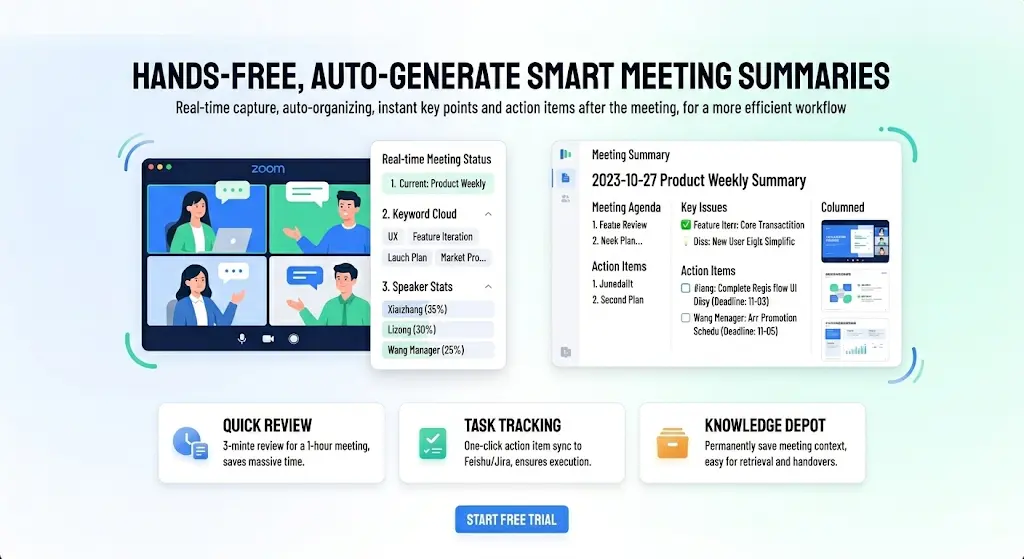
Best AI Note Taker for Zoom in 2026 — Auto Summary, Action Items & Smart Search
Compare the 6 best AI note takers for Zoom meetings. Get automatic transcription, summaries, and action items. See how they stack up on accuracy, features, and price.

How to Convert Video to Text with Visual Descriptions (2026 Guide)
In a world where 80% of internet traffic is video, text-only transcripts leave out half the story. This guide shows you how to use [Memories.ai](https://memories.ai/app) to convert video and audio into text that includes visual narratives, speaker recognition, and customized summaries.