

AI Video Analysis: Revolutionizing Industries Today
Imagine transforming months of raw footage into actionable intelligence in mere seconds. AI video analysis automates this process, supercharging operational efficiency and decision-making across your enterprise. This guide will illuminate how AI video analysis functions technically, explore its impact across various industries, highlight what makes Memories.ai's Large Visual Memory Model (LVMM) stand out, help you assess real-world ROI, contrast modern methods with older analytics, share best practices for successful adoption, and examine the future trends shaping the market. By integrating insights on Memories.ai's LVMM and API capabilities, this article empowers security teams, media creators, marketers, sports analysts, robotics engineers, and AI developers to harness video intelligence and accelerate innovation.
What is AI Video Analysis and How Does It Work?
AI video analysis leverages computer vision and machine learning to convert unstructured video into structured data, enabling automated understanding of scenes and events for faster insights. It processes raw video streams, applies deep neural networks for object detection, extracts metadata, and generates searchable representations to enhance situational awareness.
What are the Key Technologies Behind AI Video Analysis?
AI video analysis relies on computer vision for object recognition, deep learning for pattern extraction, semantic understanding for context inference, and knowledge graphs for entity relationships. These technologies combine to enable AI systems to recognize faces, actions, and interactions, boosting accuracy and facilitating real-time complex event detection. Understanding these components lays the groundwork for how persistent memory models enhance long-term video comprehension.
How Does AI Transform Unstructured Video into Structured Data?
AI transforms unstructured video by first decoding frames into pixel data, then indexing detected entities—such as objects, people, and activities—into metadata records via feature extraction algorithms. This metadata is stored in searchable databases, allowing users to query video content by entity, timestamp, or semantic label, which streamlines forensic review, content discovery, and compliance monitoring. The next step explores how persistent visual memory elevates these capabilities beyond simple indexing.
What is the Role of Persistent Visual Memory in AI Video Analysis?
Persistent visual memory refers to an AI’s ability to retain and recall visual context across extended timeframes, enabling recognition of recurring patterns and long-duration events. By maintaining a continuous memory graph, AI systems can track evolving relationships—such as a person’s repeated visits or object trajectories—enhancing anomaly detection and strategic planning. Persistent memory sets the stage for industry-scale transformations by preserving context continuity.
Which Industries Are Being Transformed by AI Video Analysis Today?
AI video analysis powers data-driven decision-making and automation across sectors, revolutionizing security, media production, marketing intelligence, sports performance, and autonomous robotics. Each industry benefits from faster insights, reduced manual effort, and deeper contextual understanding.
How Is AI Video Analysis Enhancing Security and Surveillance?
AI video analysis enhances surveillance by detecting threats, recognizing anomalies, and issuing real-time alerts, which improves response times and reduces monitoring costs.
- Identifies suspicious behavior such as loitering or perimeter breaches
- Automates face recognition for access control and watchlist alerts
- Enables post-event forensics through instant footage search
What Are the Applications of AI Video Analysis in Media and Entertainment?
AI video analysis in media empowers content discovery, scene detection, and asset management by indexing visual and audio elements within hours of footage capture.
- Tags scenes and characters for rapid highlight compilation
- Classifies content by genre, emotion, and shot type
- Integrates with production workflows for automated metadata enrichment
These efficiencies accelerate editing cycles and improve audience targeting, leading into marketing and brand intelligence uses.
How Does AI Video Analysis Improve Marketing and Brand Intelligence?
AI video analysis improves marketing by tracking brand appearances, analyzing social video sentiment, and measuring campaign performance through viewer engagement metrics.
- Detects product logos and packaging in user-generated videos
- Analyzes facial expressions and audio cues to gauge sentiment
- Correlates video impressions with conversion data in dashboards
As a result, marketers gain actionable insights into audience behavior and ROI, which parallels performance optimization in sports analytics.
In What Ways Is AI Video Analysis Revolutionizing Sports Performance?
AI video analysis revolutionizes sports by tracking player movement, evaluating tactics, and delivering performance analytics that support data-driven coaching and injury prevention.
- Monitors speed, acceleration, and positioning in real time
- Identifies play patterns and opponent tendencies
- Provides heatmaps and trend analysis for training adjustments
These insights boost athlete output and inform strategic decisions, demonstrating the power of persistent memory in autonomous systems next.
How Is AI Video Analysis Used in Robotics and Autonomous Systems?
AI video analysis in robotics uses continuous visual memory for navigation, obstacle avoidance, and contextual decision-making, enhancing autonomy and safety.
- Builds spatial maps from sequential frames for localization
- Recognizes objects and terrain features for path planning
- Maintains historical context to anticipate dynamic changes
This long-term awareness empowers robots to operate reliably in complex, unstructured environments.
What Makes the Large Visual Memory Model (LVMM) Unique in AI Video Analysis?
The Large Visual Memory Model (LVMM) is a proprietary architecture that gives AI systems persistent, searchable visual memory across extended timeframe video, unlocking deeper context and semantic relationships. LVMM transcends traditional analytics by treating past, present, and future frames as an interconnected memory graph, improving detection accuracy and enabling complex event understanding.
How Does LVMM Enable Persistent, Long-Term Visual Memory?
LVMM captures and compresses visual embeddings into a hierarchical memory store that retains entity attributes and relationships indefinitely. By indexing these embeddings with temporal and semantic tags, LVMM allows instantaneous recall of any past event, boosting situational recall and reducing search latency in massive video archives. This persistent memory capability bridges unstructured footage and structured intelligence.
What Are the Key Features of LVMM for Scalable Video Search and Querying?
- Hierarchical indexing by scene, object class, and event type
- Semantic query expansion to capture related concepts
- Distributed storage for parallel search across petabyte-scale datasets
These features shrink query times from hours to seconds, empowering enterprises to leverage vast video repositories efficiently.
How Does LVMM Bridge Unstructured Video and Structured Data?
LVMM transforms unstructured video by extracting visual entities, actions, and relationships, then populating a structured memory graph with rich metadata and semantic links. This process converts raw footage into a machine-readable knowledge base that supports advanced analytics, predictive reasoning, and integration with downstream BI tools. The result is unified video intelligence that informs real-time and strategic workflows.
How Can Developers Integrate LVMM via API and Chatbot?
Developers access LVMM through a RESTful API offering endpoints for video ingestion, metadata retrieval, and semantic search, while a web-based chatbot interface provides no-code querying for prosumers.
- API endpoints support JSON-formatted queries and streaming ingestion
- SDKs in Python and JavaScript simplify integration with existing pipelines
- Chatbot UI facilitates natural-language search across entire video memory
This flexibility accelerates product adoption and empowers technical teams to embed persistent memory into diverse applications.
What Are the Real-World Benefits and ROI of AI Video Analysis Applications?
AI video analysis drives measurable returns by reducing manual effort, accelerating investigations, and unlocking new revenue streams through data-driven insights.
Enterprises experience cost savings, productivity gains, performance improvements, and enhanced situational awareness.
How Does AI Video Analysis Reduce Security Monitoring Costs and Improve Response?
AI video analysis reduces monitoring costs by automating routine surveillance tasks and cutting false alarms by over 50 percent. Case studies show operations teams saving up to 50 percent on labor and improving incident response times by 40 percent. These efficiencies free security personnel to focus on high-value analysis and strategic threat mitigation.
What Are the Productivity Gains in Media and Marketing Through AI Video Insights?
Media producers report a 70 percent reduction in metadata tagging time, while marketers achieve a 20 to 30 percent lift in campaign engagement by optimizing video placements based on sentiment analysis. Automated indexing compresses production cycles and enables A/B testing of creative assets at scale, driving faster go-to-market and improved ROI.
How Does AI Video Analysis Enhance Sports Analytics and Athlete Performance?
Sports organizations using AI analytics see up to a 15 percent improvement in win rates through optimized training regimens and real-time tactical adjustments. Quantifiable metrics—such as reduced injury rates and increased athlete stamina—demonstrate the power of data-driven coaching informed by continuous visual memory and event prediction models.
What Are the Advantages of Long-Term Visual Memory for Enterprise Video Intelligence?
Long-term visual memory yields higher accuracy in complex event detection, with up to 80 to 85 percent improvement over short-context methods. It supports compliance audits, customer behavior analysis, and lifecycle tracking by preserving context across months or years, enabling strategic insights that evolve with business needs.
How Does AI Video Analysis Compare to Traditional Video Analytics Methods?
AI video analysis with semantic memory far surpasses frame-by-frame or short-context approaches by retaining temporal coherence and enabling richer relationship detection, delivering deeper insights and operational efficiencies.
What Are the Limitations of Frame-by-Frame and Short-Context Video Analysis?
Frame-by-frame analysis processes each image independently, causing loss of temporal continuity and context. This results in high false-positive rates, inability to detect evolving patterns, and scalability challenges when indexing large archives. Persistent memory addresses these shortcomings by linking events over time.
How Does LVMM’s Semantic Understanding Improve Event and Relationship Detection?
LVMM’s semantic layer interprets object interactions, causal sequences, and scene transitions, enabling detection of multi-step events—such as “vehicle dropping off passenger then departing”—that traditional methods miss. This deep understanding reduces misclassification and uncovers hidden patterns in complex video data.
Why Is Persistent Visual Memory a Game-Changer for Video Intelligence?
Persistent visual memory empowers AI to recall past contexts, compare historical events, and anticipate future scenarios, transforming video intelligence from reactive monitoring into proactive strategy. This capability improves anomaly detection, forensic investigations, and real-time decision support across industries.
How Can Enterprises Implement AI Video Analysis Solutions Effectively?
Effective implementation of AI video analysis requires clear integration strategies, industry-tailored configurations, deployment optimization, and rigorous performance measurement to maximize value.
What Are the Best Practices for Integrating AI Video Analysis APIs?
Enterprises should adopt modular integration, beginning with proof-of-concept deployments on representative data, then iterating model tuning and metadata schemas. Key practices include:
- Defining clear ingestion pipelines and storage policies
- Customizing entity labels and semantic taxonomies
- Implementing robust authentication and monitoring
These steps ensure stable performance and ease of scaling.
How Do Industry-Specific Solutions Tailor AI Video Analysis for Unique Needs?
Industry solutions custom detection models, UI dashboards, and alert rules to domain requirements—for example, focusing on intrusion patterns for security, scene cuts for media workflows, sentiment cues for marketing, biomechanics for sports, and mapping for robotics. Tailoring these parameters accelerates time to value.
What Are the Key Considerations for Cloud vs. Edge AI Video Processing?
Cloud deployments provide scalable compute for large-scale indexing and cross-site analytics, while edge processing reduces latency for real-time alerts and privacy-sensitive use cases. Hybrid architectures leverage edge inference with periodic cloud synchronization to balance performance, cost, and data governance.
How Can Organizations Measure Success and ROI from AI Video Analysis?
Organizations should track KPIs such as reduction in manual review hours, improvement in detection accuracy, time-to-insight metrics, and cost savings. Complementing quantitative metrics with user satisfaction surveys and strategic outcome measures ensures comprehensive evaluation and continuous optimization.
What Are the Future Trends and Challenges in AI Video Analysis Applications?
Rapid advances in deep learning, demand for real-time intelligence, and growing expectations for semantic AI pose both opportunities and challenges for video analysis technologies.
How Will Advances in Deep Learning and Semantic Search Shape AI Video Analysis?
Emerging models will integrate multi-modal understanding, combining video, audio, and text to deliver unified semantic search capabilities. Graph-based architectures will enhance relationship reasoning, while transformer-based video encoders will improve event prediction and anomaly detection accuracy.
What Are the Growing Industry Demands Driving AI Video Analytics Market Growth?
Rising needs for smart city monitoring, automated customer analytics, remote operations, and autonomous system management are driving a projected CAGR of around 25 percent through 2030. Industries seek scalable, explainable, and compliance-ready solutions to meet regulatory and operational requirements.
What Challenges Remain in AI Video Analysis Adoption and Accuracy?
Key challenges include data privacy concerns, computational cost of processing high-resolution streams, model bias in detection, and the need for labeled training data. Addressing these hurdles requires federated learning, optimized hardware acceleration, and transparent model governance frameworks.
How Is Memories.ai Leading Innovation with LVMM and Industry Partnerships?
Memories.ai pioneers persistent visual memory with LVMM, collaborating with research labs and industry partners to refine semantic models and expand use cases. Strategic alliances with cloud providers and system integrators accelerate global adoption, while ongoing R&D ensures that LVMM remains at the forefront of video intelligence innovation.
Memories.ai’s LVMM architecture demonstrates how persistent visual memory transforms unstructured video into strategic intelligence, driving efficiency and insight across security, media, marketing, sports, and robotics. By following best practices for API integration, tailoring solutions to industry requirements, and benchmarking ROI with clear metrics, enterprises can unlock the full potential of AI video analysis. As deep learning and semantic search evolve, LVMM’s scalable memory graph provides a future-proof foundation for advanced video intelligence. Explore Memories.ai’s developer API and chatbot interface to begin embedding long-term visual memory into your workflows today.
Read more

Best Meeting Transcription Software in 2026 (Tested & Compared)
We tested 8 meeting transcription tools head-to-head. Compare accuracy, AI summaries, pricing, and integrations to find the best fit for your team.
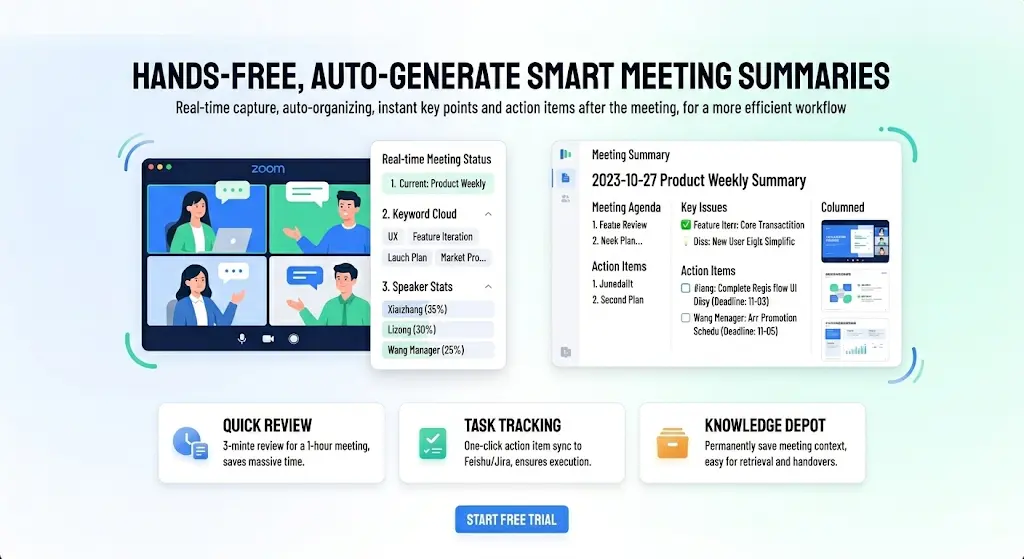
Best AI Note Taker for Zoom in 2026 — Auto Summary, Action Items & Smart Search
Compare the 6 best AI note takers for Zoom meetings. Get automatic transcription, summaries, and action items. See how they stack up on accuracy, features, and price.

How to Convert Video to Text with Visual Descriptions (2026 Guide)
In a world where 80% of internet traffic is video, text-only transcripts leave out half the story. This guide shows you how to use [Memories.ai](https://memories.ai/app) to convert video and audio into text that includes visual narratives, speaker recognition, and customized summaries.